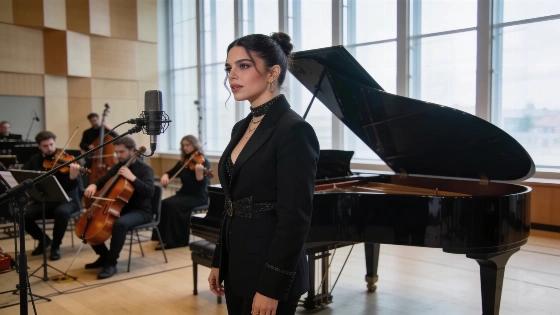
Rosalía has received Spain's 2026 National Contemporary Music Award for 'LUX'. The jury praised the album's reach, experimentation and role in taking Spanish music to audiences abroad.
The Ministry of Culture awarded Rosalía Vila Tobella the 2026 Premio Nacional de las Músicas Actuales for 'LUX' (2025). The prize comes with 30,000 euros. EFE, El País and El Mundo also reported the award.
The jury pointed to the album's ambition, innovation and ability to reshape expectations. Its decision focused on one release, not simply on Rosalía's career. El Español explains that the rules generally allow the prize to recognise a work or performance published during the previous year. Career-based recognition is reserved for exceptional cases. A 2025 album therefore fits the award's established practice of honouring major releases as well as long careers.
'LUX' uses 13 languages, adding a distinctly international dimension to Rosalía’s fusion of pop, classical music and flamenco influences.
The decision puts 'LUX' at the center of Rosalía's international career.
The jury valued the research, risk and constant change that have shaped her work. It praised her search for a distinctive sound that moves across genres, styles and periods. The album brings avant-garde ideas together with musical heritage, and it also connects artists from different backgrounds. El Mundo reported that the jury saw collaboration as part of Rosalía's creative process, not as an extra feature.
'LUX' was recorded with the Orquesta Sinfónica de Londres. Silvia Pérez Cruz, Carminho, Björk and Estrella Morente also contributed. Those partnerships helped shape the album and formed part of the jury's reasoning.
According to RYM Magazine, 'LUX' debuted at No. 4 on the Billboard 200, Rosalía’s best opening on that chart. It also reached No. 1 in several Billboard categories, including Top Latin Albums, Classical Albums and World Albums.
The award follows a run of releases that made Rosalía one of Spain's best-known contemporary musicians outside the country. She released her first album, 'Los Ángeles', in 2017 with producer and musician Raül Refree. A year later, she put out 'El mal querer', coproduced with El Guincho. The album included 'Malamente' and 'Pienso en tu mirá'.
In 2022, 'Motomami' mixed Latin urban rhythms with flamenco and electronic music. 'LUX' takes that movement into a larger orchestral setting and adds more collaborators. Vulture describes it as a sharp break from the expected follow-up to 'Motomami'. Its classical and flamenco elements form part of a deliberate artistic change rather than a straightforward sequel. Coverage of major international recognition has also featured in recent Nobel reporting, although Rosalía's award belongs to Spain's national cultural honours.
Rosalía was born in Sant Esteve Sesrovires, Barcelona, in 1992. She is a singer, songwriter, producer and performer. Her international standing is also reflected in two GRAMMY Awards and thirteen Latin GRAMMYs, including the Album of the Year award.
Javier Monsalve Iglesias chaired the 2026 jury. He is director general of Artes Escénicas y Música. Paz Santa Cecilia Aristu, director general of the Instituto Nacional de las Artes Escénicas y de la Música, served as vice-chair. The other members were Ana Belén Faus Guijarro, Nuria Sempere Comas, Isabel Villanueva Benito, Rubén Gutiérrez del Castillo, José Luis Sevillano Romero, Almudena Heredero Borreguero and Antonio Serrano, the previous recipient.
The prize's recent winners include Antonio Serrano in 2025, Tulsa in 2024, Rodrigo Cuevas in 2023, Sílvia Pérez Cruz in 2022, Rozalén in 2021, Chano Domínguez in 2020, Mala Rodríguez in 2019 and Christina Rosenvinge in 2018. Earlier recipients include Javier Ruibal, Martirio, Jorge Pardo, Carmen París, Luz Casal, Kiko Veneno, Santiago Auserón, Amaral and Joan Manuel Serrat.
For the Ministry of Culture, 'LUX' represents another expansion of Rosalía's musical vocabulary. The award recognises its experimentation, international collaboration and link between new ideas and musical heritage. It also places the album within a Spanish music tradition that reaches beyond one genre.