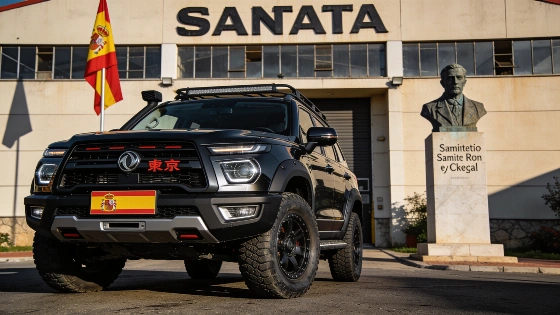
Santana is preparing to launch the Cajal, its first all-terrain vehicle produced in Linares. With diesel and petrol options, the model aims to combine off-road capability, comfort, and a nod to Spain’s scientific legacy. The official reveal is scheduled for July.
Santana is set to re-enter the Spanish automotive scene with the Cajal, a new 4x4 that will roll off the production line in Linares, Jaén, later this year. Named in honor of Santiago Ramón y Cajal, the Nobel Prize-winning neuroscientist, the vehicle marks a significant step for the brand as it seeks to blend affordability, robust engineering, and a distinctly Spanish identity.
The Cajal is based on the BAIC BJ40, a proven off-road platform from China, but Santana has tailored the model for the Spanish market. Measuring 4.7 meters in length and 1.9 meters in both width and height, the Cajal fits squarely into the D-segment, offering generous interior space and seating for five. Its 2.7-meter wheelbase is designed to maximize comfort and practicality, whether for rural work, daily commuting, or weekend escapes into nature.
Off-road credentials are a core part of the Cajal’s appeal. Drawing from the BJ40’s specifications, the vehicle boasts a 37-degree approach angle, a 23-degree breakover angle, and a 31-degree departure angle. Ground clearance stands at 220 mm, while the wading depth reaches up to 800 mm, making it well-suited for challenging terrain.
Underpinning the Cajal is a multi-technology platform that supports a range of powertrains. At launch, buyers will be able to choose between diesel and petrol engines, both paired with an automatic transmission and permanent 4WD as standard. The transmission is expected to be an eight-speed unit sourced from ZF, known for its reliability in demanding conditions. Later, Santana plans to introduce a version with extended-range electric technology, which will carry Spain’s coveted DGT “0” emissions label.
The official unveiling of the Cajal is scheduled for July in Linares, where Santana will share further details about pricing, equipment, and availability. The company has emphasized that the Cajal is not just a new model, but the beginning of a tradition: future vehicles will also be named to honor Spain’s history, regions, and influential figures, reinforcing the brand’s commitment to national heritage.
Choosing the name Cajal is a deliberate tribute to one of Spain’s most celebrated scientists. Santiago Ramón y Cajal’s legacy as a pioneer in neuroscience symbolizes innovation, perseverance, and excellence—values Santana aims to embed in its new era. The company’s approach echoes that of other brands, such as Seat and Cupra, which have also drawn inspiration from Spanish culture and history in their model names.
For drivers considering the long-term costs of ownership, the choice of transmission can be crucial. As highlighted in a recent analysis of gearbox failures and repair costs, the reliability of automatic systems—like the ZF unit expected in the Cajal—can have a significant impact on maintenance expenses. For more on this topic, see the breakdown of transmission issues and costs in this detailed report on gearbox failures.
With the Cajal, Santana is not only reviving its manufacturing legacy in Spain but also signaling a renewed focus on vehicles that reflect the country’s character and aspirations. As the official launch approaches, the Cajal stands out as a symbol of both technological ambition and cultural pride in the Spanish automotive landscape.