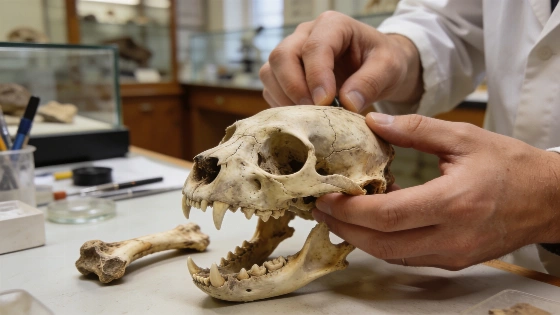
New research highlights Proailurus, an ancient predator from Eurasia, as the earliest true cat and the ancestor of all modern felines. Its fossils shed light on how domestic cats, lions, and tigers evolved from a tree-dwelling hunter that vanished 25 million years ago.
Fossil discoveries in Europe and Asia have revealed that the story of modern cats begins with a little-known predator called Proailurus, which roamed Eurasian forests between 30 and 25 million years ago. Weighing between 7 and 10 kilograms in most species, Proailurus is now recognized as the earliest true member of the Felidae family, the group that includes domestic cats, lions, tigers, and leopards.
The name Proailurus comes from Greek, meaning “before the cat.” This genus emerged in the late Oligocene, after feliforms split from other carnivorous mammals. While Proailurus shared some features with today’s cats, it also displayed more primitive traits: an elongated body, short legs, and a long, flexible tail, all of which made it well-suited for life in the trees.
Origins in the Trees
Three species of Proailurus have been identified from fossil records. Two, Proailurus lemanensis and Proailurus bourbonnensis, were similar in size to large domestic cats. The third, Proailurus major, was significantly larger, though only a single specimen has been found, leaving many questions about its biology.
Proailurus likely resembled a miniature puma, with a long, low back and agile limbs. Its anatomy suggests it was adapted for climbing and hunting among branches, but it also foraged on the ground. This body plan is reminiscent of Madagascar’s fossa, a modern predator with a cat-like appearance but from a different family. The similarity is an example of convergent evolution, where unrelated species develop similar adaptations to comparable environments.
Widespread Expansion
The first Proailurus fossils were described in 1879 by French naturalist Henri Filhol, who found small remains in central France. Since then, fossils have been unearthed in Spain, Germany, and Mongolia, indicating that Proailurus had a broad range across Eurasia and occupied various forested habitats with little direct competition.
Similar fossils have also been found in North America, such as the so-called Ginn Quarry cat, whose skull closely resembles that of Proailurus lemanensis. However, experts have yet to confirm whether these animals truly belonged to the Proailurus genus. The dental similarities suggest that early cats or their close relatives may have crossed from Eurasia to North America during this period.
Diet and Evolutionary Traits
Analysis of jaws and teeth shows that Proailurus was a predator, feeding mainly on small mammals, birds, and lizards, both on the ground and in the trees. Its hunting style likely resembled that of modern arboreal cats like the margay or marbled cat, which use agility to pursue prey in dense forests.
While primarily carnivorous, Proailurus retained some extra premolars not found in modern cats. These robust teeth may have helped it process tougher foods, reflecting an evolutionary stage between earlier carnivores and today’s specialized felines. Proailurus marks a key point in the evolution of the Felidae, which began with small, nocturnal predators over 50 million years ago and later split into caniforms and feliforms. Proailurus, appearing around 30 million years ago, set the stage for the agile, meat-eating cats we know today.
Disappearance and Legacy
The last Proailurus lived at the dawn of the Miocene, about 25 million years ago, as Eurasian forests gave way to expanding grasslands. This environmental shift likely threatened a species so well adapted to life among the trees, forcing it into unfamiliar habitats where it struggled to survive.
Its extinction coincided with a “cat gap” in North America, a seven-million-year period with no clear feline fossils. Possible explanations include climate change, increased volcanic activity, and competition from early dogs, though some researchers suggest the fossil record may simply be incomplete.
Cats reappeared in North America around 18.5 million years ago with the arrival of Pseudaelurus, a genus that spread across Europe, Asia, and North America and gave rise to later lineages, including saber-toothed cats and the ancestors of today’s felines. From these branches emerged the Felinae (small cats, cheetahs, pumas) and Pantherinae (lions, tigers, leopards, jaguars), all tracing their roots back to the ancient forests where Proailurus once hunted.
As research continues, Proailurus stands as a crucial link in the evolutionary chain, offering a rare glimpse into how the world’s most familiar predators began their journey millions of years ago.