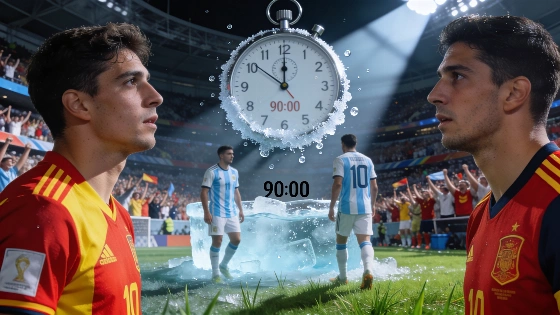
Spain will enter the 2026 World Cup final with one more rest day than Argentina. Experts see a slight edge for Spain. Recent tournament data supports this view.
Spain will approach the 2026 World Cup final with a notable advantage: an extra day of rest compared to Argentina. This scheduling detail, confirmed after Spain's 2:0 semifinal win over France on Tuesday and Argentina's comeback against England a day later, has drawn attention from sports scientists and analysts. The difference in recovery time is seen as a potentially decisive factor, especially at this late stage of the tournament.
According to Professor Thimo Wiewelhove, a training science specialist at the German Sport University Cologne, the additional day allows Spanish players more time to recover from the physical demands of high-level football. He points out that every match causes microtraumas in the muscles, commonly known as muscle soreness, and can trigger inflammation. While both teams have access to advanced recovery methods such as ice baths, the simple rule remains: more time means better regeneration. Wiewelhove also notes that the extra day can help Spain avoid building up tension too early before the final.
Both teams will play their eighth match of the tournament in the final, under identical conditions in terms of pitch, temperature, and humidity. However, the scheduling difference stands out. Spain's squad, led by Luis de la Fuente, benefits from a longer break, while Argentina, despite their resilience, faces a tighter turnaround. The importance of proper hydration, nutrition, and sleep is heightened in this context, as players aim to restore energy reserves and minimize fatigue. Training intensity is expected to remain low for both sides, focusing on maintaining ball control and tactical routines rather than physical exertion.
Recent tournament history appears to support the idea that an extra rest day can be significant. Since Euro 2012, the team with more recovery time before the final has consistently lifted the trophy. This trend includes Spain's own victory over England in the Euro 2024 final and Argentina's penalty shootout win against France in the 2022 World Cup. However, there are notable exceptions: Spain won the 2010 World Cup and Euro 2008 finals despite having less rest than their opponents, and Germany claimed the 1990 World Cup under similar circumstances.
Argentina, meanwhile, has demonstrated a capacity to overcome scheduling disadvantages. The team, led by Lionel Messi, won the 2021 Copa América final against Brazil after a shorter rest period and has repeatedly advanced through extra time in recent knockout rounds. Their ability to manage fatigue and maintain focus under pressure has become a hallmark of their recent tournament runs. In the current World Cup, Argentina entered the competition two days later than Spain, played two extra-time matches, and now faces a final with less recovery time. Despite these challenges, their determination and experience remain key assets.
Fan dynamics have also played a role in the tournament's atmosphere. For example, the semifinal between Argentina and England was marked by intense crowd energy and early incidents, as reported in a related piece on crowd tensions during the Argentina-England semifinal in Atlanta. Such factors, while not directly affecting player recovery, contribute to the overall pressure and unpredictability of the final stages.
Looking at the broader context, the debate over rest days is not new in international football. While recent data suggests a correlation between longer recovery and success, the outcome of a final still depends on a complex mix of tactics, mental strength, and in-game decisions. The 2026 final will test whether Spain's extra day off translates into a tangible advantage or if Argentina's resilience once again defies the odds. As anticipation builds, both teams prepare for a decisive match that could add a new chapter to World Cup history.