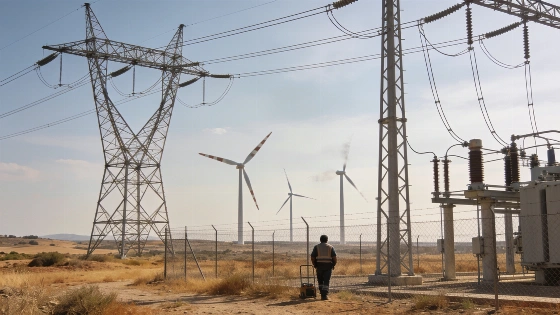
Spain is curtailing record renewable output as saturated grid nodes block new connections. The strain is extending Almaraz reactors while emissions continue to rise.
Excess generation was discarded across Spain during the summer of 2026 because electricity demand could not absorb it. Nuclear power regained a role the government had planned to reduce.
The immediate problem is operational. Spain has more installed capacity than the grid can effectively manage, leaving new renewable facilities struggling to secure connections and earn their expected income. Data centres have brought the constraint into sharper focus. Government regulation has imposed requirements that new industrial users find difficult to meet instead of clearing the way for additional connections.
По данным, приведённым ассоциацией Aelec, 83,4% узлов распределительной сети Испании уже насыщены.
That is the contradiction at the centre of Spain’s green transition: generation is expanding while access to the network is narrowing. Infrastructure constraints reportedly prevented 66% of declared electricity demand from being met in 2024.
The pressure has changed the timetable for nuclear power.
In the summer of 2026, electricity companies asked to extend operation of both Almaraz reactors until June 2030. Spain’s Nuclear Safety Council assessed the request, and it was accepted. The decision delays the closure of the first reactors scheduled to leave the system. It is intended to help balance the grid as renewable generation grows.
Keeping Almaraz online also limits reliance on gas. Gas-fired generation can push electricity bills higher when the system needs extra support, making the reactors part of the effort to manage the mismatch between supply and network capacity.
CEOE поддержала продление Almaraz, назвав его реализацией многолетнего требования бизнеса. При этом источники, связанные с Red Eléctrica, считают эффект для энергосистемы полезным, но ограниченным: продление не устраняет структурный дефицит сетевой инфраструктуры.
The political backdrop was set by the blackout of 28 April 2025, when the Iberian Peninsula was left without electricity for almost an entire day. The outage put Spain’s infrastructure under direct scrutiny and turned network resilience from a technical issue into a central test of energy policy.
The blackout investigation has moved beyond a purely technical dispute. Spain’s competition regulator CNMC is preparing its first sanctions. Some alleged breaches may have existed long before the outage. Energy companies say they lack data showing improper disconnections during the blackout, while Red Eléctrica has demanded a fuller and more technically grounded analysis from them.
During Pedro Sánchez’s second term, the Ministry for the Ecological Transition was first led by Teresa Ribera and later by Sara Aagesen. Both followed a continuity agenda focused on the green transition. Aagesen’s tenure was shaped by the blackout and by the difficulty of integrating rising renewable production into a network that was not prepared for current demand.
Red Eléctrica operates the system while the government controls infrastructure planning. That division has left the country with a practical constraint: generation can be added faster than the connections and flexibility needed to use it. The figures cited by Aelec point to systemic restrictions rather than a few isolated local bottlenecks.
The emissions data add pressure. Red Eléctrica reported 21.2 million tonnes of CO2 equivalent during the first nine months of 2026, 3% more than in the same period a year earlier. The increase followed a reinforced operating mode designed to strengthen the electricity mix. Emissions had already risen by 9% before that latest deterioration.
Transport is moving in the wrong direction as well. Spain is expanding renewable capacity without delivering a comparable reduction in emissions.
An earlier report on renewable gas projects showed the same infrastructure risk: investment can advance on paper while the network decides whether new capacity can operate profitably.
Spain now faces a connection problem alongside its generation push. The Almaraz extension shows that nuclear power has returned as a practical balancing tool. Record curtailment and higher emissions are exposing the cost of a network that has lagged behind policy ambition.
The decision does not formally cancel Spain’s nuclear phase-out. The government still retains its plan to close the country’s nuclear fleet by 2035 while allowing Almaraz to operate until June 2030. Nuclear capacity is therefore being retained while the grid is saturated and demand for dispatchable generation is increasing.
The government’s energy strategy has accelerated generation without providing enough network capacity to turn that expansion into reliable, cleaner electricity.