Ramón Larramendi is due to lead an 85-day crossing of Antarctica from 18 October. The wind-powered vehicle will carry 16 research projects across 3,400 kilometres of largely unstudied ice.
On 18 October, Ramón Larramendi is due to begin an 85-day crossing of Antarctica. The team will travel 3,400 kilometres to the Italian base of Concordia. Much of the route passes through areas with little scientific data.
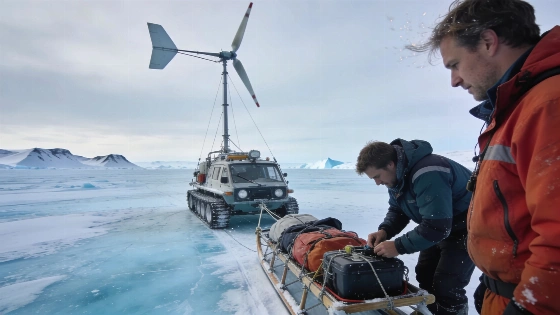
The expedition will use the 15-metre Trineo de Viento. Its sails can drive the vehicle to 80 kilometres per hour, while solar panels will power the scientific equipment. Organizers describe the crossing as the first to combine a fully wind-powered traverse with zero-emission scientific work.
В конце сентября 2026 года испанский XL антарктический контингент готовился к отправке в Антарктику. Доступный материал AS не связывает этот контингент напрямую с проектом Рамона Ларраменди.
The route will begin near Russia's Novolazárevskaya base in the Tierra de la Reina Maud. It will end at Concordia, on the ice plateau known as Domo C. The plan includes five extended stops for experiments. The team is expected to return in early February.
The sled will carry 250 kilograms of scientific material.
That is the load.
Внешняя проверка не смогла независимо подтвердить заявленные параметры перехода, включая протяжённость маршрута, 85-дневную продолжительность, пять научных остановок, состав экипажа, грузоподъёмность и максимальную скорость. Поэтому эти характеристики в данном материале следует рассматривать как заявленные организаторами проекта.
Larramendi and three other expedition members will live on the sled until February. The vehicle has cabins and solar panels. A separate tent will also form part of the camp. The group includes three Spaniards and a Polish scientist.
After landing at the South Pole, the team will travel east across the ice toward Concordia. The journey will start from a Russian base that still has a statue of Vladímir Lenin.
The research covers atmospheric pollution and planetary exploration. Scientists from the Centro de Biología Molecular Severo Ochoa, led by Antonio Alcamí, will collect air samples in search of emerging viruses in the continent's interior. Portable laboratories with genetic sequencers will let the team confirm findings by PCR and identify viral mutations without sending samples to Spain.
The researchers want to find out whether pathogens such as avian flu H5N1 may spread through isolated animal colonies. They will also map how those viruses mutate in one of the planet's most remote environments. The project will examine the possible effect of a viral presence on the polar ecosystem.
The question is biological.
The Centro de Investigaciones Energéticas, Medioambientales y Tecnológicas will search for signs of human activity in the atmosphere over the isolated interior of East Antarctica. Researchers from the Universidad de Oviedo will study how pollution and dust affect the ice's ability to reflect sunlight. Earlier snow research has also examined what reduced reflectivity can do in colder environments.
The expedition will test conditions linked to future human missions to the Moon and Mars. The Universidad de Alcalá de Henares will monitor how the crew handles extreme cold. That work is one of the 16 research lines connected to space exploration.
Larramendi's design combines modern equipment with knowledge he learned from the Inuit. He speaks their language and has studied their understanding of polar terrain through earlier experience among them. That tradition influenced the vehicle's design. The scientific systems have gone through more than three years of testing and adjustment.
The Ministry of Science, Innovation and Universities backs the campaign. NASA and six Spanish universities are also involved. Secretary of State for Science Juan Cruz Cigudosa said the project shows Spain's research capacity and represents a radical change in the country's approach to Antarctic strategy.
The available AS report covers preparations for Spain's XL Antarctic contingent. It does not independently verify the expedition's scientific program or its connection with Larramendi's project.
The mission will test whether a wind-powered vehicle can carry laboratories and instruments into Antarctica's interior. Those areas have been hard to reach because of the logistics involved. If the planned work succeeds, Spain will place atmospheric, biological, environmental and human-performance experiments in places that have barely been studied.
The vehicle's wind and solar systems give the expedition a low-impact operating model. Its most useful result will be the data gathered in areas where sustained research has so far been difficult.