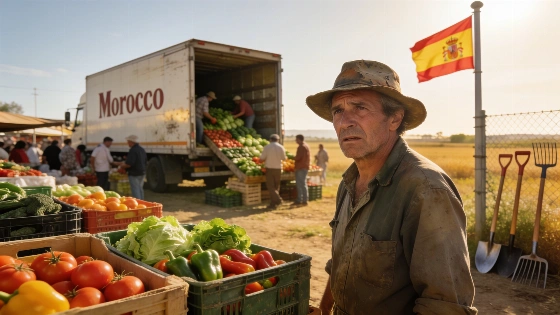
Alberto Tomás, a farmer from La Rioja, warns that Spanish agriculture is under threat as companies move production to Morocco, taking advantage of lower labor costs. He argues that strict regulations and rising expenses are making it harder for Spanish farmers to survive.
Alberto Tomás, a farmer from Quel in La Rioja, has become a prominent voice for Spanish agriculture, raising concerns about what he describes as unfair competition from Moroccan imports. In a recent interview on the podcast of Germán Agrolife, Tomás criticized Spanish companies that shift their cultivation to Morocco, only to re-import the produce back into Spain at prices local farmers cannot match.
“Many companies from Spain go to Morocco to grow crops and then bring them back here because, over there in Morocco, forgive the expression, they give a sandwich to the boy who is harvesting,” Tomás stated, highlighting the stark difference in labor conditions and costs between the two countries.
Mounting Pressures on Spanish Farmers
Tomás points out that Spanish farmers are required to comply with strict regulations, pay higher wages, and shoulder increasing costs for insurance, fertilizers, and agricultural diesel. Meanwhile, products from outside the European Union, particularly Morocco, enter the Spanish market with far lower production costs, putting local growers at a disadvantage.
“I want my crops to be paid for, and I don’t want unfair competition,” Tomás emphasized, arguing that the issue is not just about subsidies but about ensuring that agricultural products fetch prices that allow farmers to make a living.
Struggling for Profitability
With over a decade of experience managing his family’s 45 hectares, Tomás cultivates a diverse range of crops, including vineyards, almonds, olives, plums, broccoli, and cherries—his personal favorite. He has also revived the traditional four-lobed ‘pimiento del cristal’ pepper, selling it both fresh and preserved under his own brand.
Despite his success, Tomás admits that maintaining profitability is a constant challenge. The rising costs of fertilizers and diesel have squeezed margins, forcing many farmers to cut expenses wherever possible just to keep their operations afloat.
Destructive Solutions Reflect Deeper Problems
One of the most telling signs of the sector’s difficulties, according to Tomás, is the practice of ‘green harvesting’—destroying part of the grape crop to reduce supply when prices are too low. He acknowledges having resorted to this measure himself, finding it more economically viable than selling grapes at unprofitable prices. Still, he describes the need to destroy food for financial reasons as “aberrant.”
Through his social media presence as AgriBerto, Tomás documents the realities of rural life, advocates for local products, and encourages young people to consider farming as a rewarding career. His candid approach has resonated with many, making him a widely followed figure among Spain’s agricultural community.
As the debate over imports and agricultural policy continues, Tomás’s experience underscores the urgent need for solutions that level the playing field for Spanish farmers. According to data from the Spanish Ministry of Agriculture, imports of fruits and vegetables from Morocco have grown steadily in recent years, intensifying competition and fueling calls for regulatory changes to protect domestic producers.