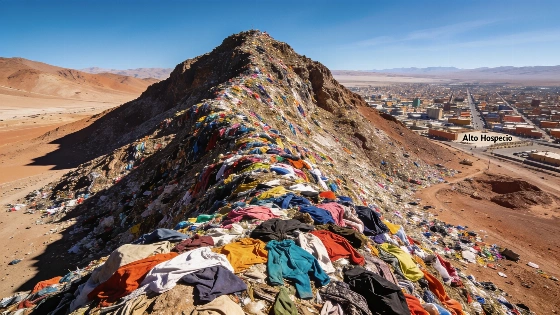
A vast pile of unwanted clothing, mostly from Europe, has accumulated near Alto Hospicio in Chile’s Atacama Desert. The dump, now exceeding 60,000 tons and visible in satellite images, is polluting the environment and impacting local residents as authorities struggle to contain the crisis.
From the outskirts of Alto Hospicio, a city in northern Chile, a mountain of discarded clothing sprawls across the Atacama Desert—so large that its outline can be seen from space. Satellite imagery confirms what locals have witnessed for years: more than 60,000 tons of unwanted garments, much of it shipped from Europe, now form a growing textile landfill that the United Nations has labeled an “environmental and social emergency for the planet.”
The clothing arrives in Chile as part of the global trade in second-hand textiles. According to a 2024 United Nations report, the European Union is the world’s largest exporter of used clothing, accounting for 30% of global exports, followed by the United Kingdom (16%) and the United States (15%). Each year, nearly 450 million EU residents buy an average of 26 kilos of textiles and discard 11 kilos, with a significant portion ultimately traveling thousands of kilometers to end up under the relentless Atacama sun.
How Clothes End Up in the Desert
The journey begins with bales of used clothing leaving Europe and arriving at the port of Iquique, a duty-free zone in northern Chile. Importers bring these garments to Alto Hospicio, hoping to sell them locally or distribute them to other Latin American markets. However, many items—often of low quality or lacking commercial value—fail to find buyers. When resale is not possible, no party assumes responsibility for disposal, and the unsold bales are abandoned in the desert.
The scale of the problem is staggering. Data from January 2026 shows that Iquique receives between 120,000 and 180,000 tons of used clothing annually, making Chile the world’s fourth-largest importer of second-hand apparel. This relentless influx explains why the dump continues to expand despite growing international attention.
Brands Among the Waste
Investigations by the NGO Ekō and the Chilean group Desierto Vestido have identified clothing from brands such as H&M, Zara, Hugo Boss, Adidas, Levi’s, Old Navy, Under Armour, Tommy Hilfiger, and Nike among the heaps. The piles include everything from Christmas sweaters to ski boots, with some items still bearing their original tags. Yet, the presence of well-known brands does not mean the clothing is reusable; much of it is classified as third-rate or unsellable, highlighting the consequences of fast fashion and the limits of the global second-hand trade.
The dump first drew global notice in 2020, when local activists published striking photographs of the site. Subsequent analysis using images from the European Space Agency’s Copernicus program tracked the dump’s expansion from November 2016 to November 2024, confirming that the area covered by textile waste continues to grow.
Burning Clothes, Spreading Pollution
To reduce the volume, some of the clothing is buried or burned by informal operators. Fires melt synthetic fabrics and plastics, leaving a dark residue on the ground. As described by activist Bastian Barria, the result “looks like solidified oil, but it’s actually the remains of clothing fused by fire.”
Most synthetic textiles contain polyester derived from petroleum. When burned, they release toxic compounds into the air and potentially into groundwater. The Scientific Plastic Pollution Alliance of Chile and Desierto Vestido have documented that burning clothes and plastics together creates chemical mixtures with unpredictable health effects. Smoke from these fires disrupts daily life in nearby neighborhoods, forcing residents to stay indoors and seal their homes. Alto Hospicio’s mayor, Patricio Ferreira, summed up local frustration: “We feel like our land has been sacrificed. We are the world’s trash.”
The city’s reputation has also suffered. Karla Aviles of Desierto Vestido notes that Alto Hospicio is now associated online with videos portraying it as one of the world’s most unpleasant places—a notoriety its residents never sought.
Legal Action and New Regulations
Mounting public pressure has reached the courts. In 2025, the First Environmental Court of Antofagasta found the Chilean state responsible for failing to prevent or monitor illegal dumping of textile waste on public land in Alto Hospicio, ordering a ten-year environmental remediation plan. However, the ruling is not final: the State Defense Council has appealed to the Supreme Court, leaving the ultimate outcome unresolved. The decision addresses state responsibility in this specific case and does not guarantee immediate removal of the thousands of tons already dumped or buried.
Chile has also extended its producer responsibility law to the textile industry, requiring importers to manage the waste generated by their products. According to the University of Chile’s Sustainability Observatory, about 70% of post-consumer clothing is donated or discarded, while only 1% is recycled—a challenge for any new regulation.
The crisis has grown alongside the global trade in used clothing. A United Nations report notes that the rise of fast fashion and constant collection turnover have multiplied second-hand clothing flows sevenfold over the past four decades.
Some private initiatives are attempting to repurpose the waste. The company EcoFibra, for example, manufactures insulation panels from abandoned clothing, but faces obstacles due to chemical residues that prevent the textiles from being treated as regular municipal waste. Meanwhile, new bales from European wardrobes continue to arrive in Atacama each week, underscoring the scale and persistence of the problem.