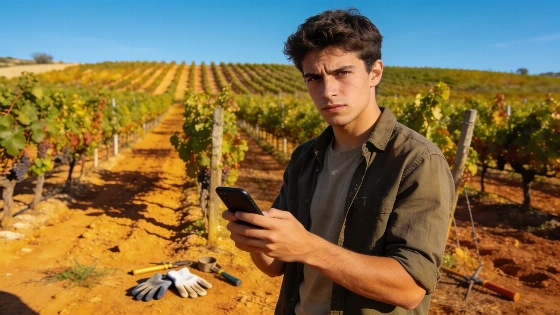
Mario Selo, 23, left his industrial mechatronics studies to run his family's farm in Madridejos. Despite offering €70 per day during harvest, he faces a shortage of young Spanish workers willing to join his team, highlighting a growing generational gap in agriculture.
At just 23, Mario Selo made a decisive break from his technical studies in industrial mechatronics to take over his family's agricultural business in Madridejos, Toledo. Despite offering €70 per day during the harvest season—a sum that can reach €1,540 for 22 days of work—Mario faces a persistent challenge: attracting young Spaniards to join his crew in the fields.
Mario's connection to farming runs deep. Raised alongside his father and uncle, he learned the rhythms of sowing, pruning, fertilizing, and harvesting from an early age. After completing his advanced degree, he chose the unpredictability of the land over the stability of an industrial job, managing vineyards, olive groves, almond trees, and pistachios on the family plot.
Unstable Income, Uncertain Future
While the daily wage he offers is competitive—surpassing the average gross monthly salary of €1,372.8 for Spaniards under 25, according to the National Statistics Institute—Mario is quick to point out that agricultural income is anything but steady. Profits depend on the harvest, fluctuating market prices, and the whims of the weather. In lean years, he supplements his earnings by working for other farms, a reality familiar to many in Spain's rural heartland.
Even with these incentives, Mario finds it difficult to recruit young Spanish workers. His first attempts to assemble a team of under-25s relied on friends and acquaintances, most of whom had no prior experience in agriculture. The struggle is not unique to his region: across the European Union, the average age of farmers is 57, and only 12% are under 40. The European Commission has set an ambitious goal to double the number of young farmers by 2040, but the path remains steep.
Social Media as a Recruitment Tool
To bridge the gap, Mario turned to social media. He began by sharing instructional videos on pruning and harvesting in private WhatsApp groups, later expanding his reach to Instagram and TikTok under the handle @agr.selo. With nearly 10,000 followers across both platforms at the time of his interview, Mario uses digital channels to demystify farm work and attract a new generation to the fields. While some young Spaniards have responded, they remain a minority among his seasonal crews.
Mario's approach highlights the potential of social media to connect rural jobs with urban youth, but it also underscores the deeper issues facing Spanish agriculture: inconsistent earnings, limited career prospects, and the ongoing exodus of young people from rural areas. The sustainability of the sector, as Mario sees it, depends not only on wages but on creating viable long-term opportunities for newcomers.
Generational Tensions and Policy Challenges
The difficulties Mario faces are echoed in other corners of Spain's agricultural sector. For example, a recent court case in La Rioja saw a retired farmer ordered to repay nearly €47,000 after authorities determined he continued managing his farm while drawing a full pension—a reminder of the complex legal and economic pressures shaping rural life. (Read more about the pension and farm work conflict in La Rioja.)
As policymakers push for generational renewal in agriculture, stories like Mario's reveal both the promise and the limits of grassroots solutions. Without broader reforms to stabilize incomes and improve rural prospects, the challenge of attracting young talent to the fields is likely to persist.