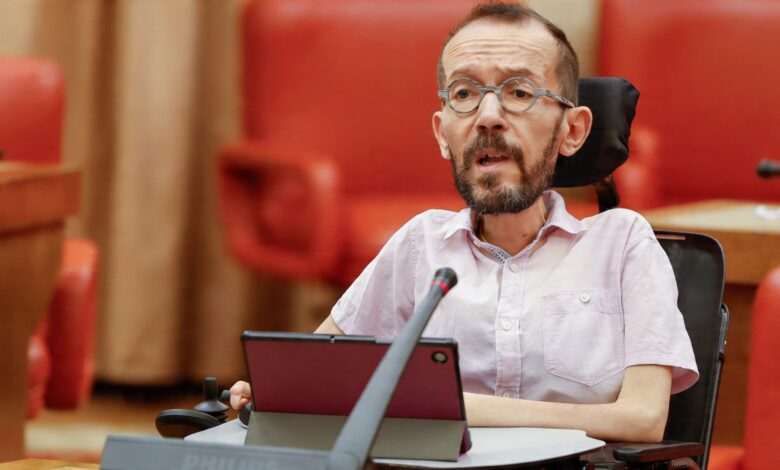
The court’s ruling in the Pablo Echenique case became a notable event in Spanish society, where debates over freedom of speech and the limits of public discourse are especially intense. The acquittal of the former Podemos MP on charges of inciting hatred, following his remarks about clerics, sparked widespread discussion. For many Spaniards, this verdict suggests that the judiciary is not prepared to treat sharp criticism as a criminal offense unless there is a clear call for violence or discrimination.
As reported by El Pais, the case began after Echenique posted on social network X, where he compared the likelihood of crimes committed by clergy and migrants. The Abogados Cristianos foundation demanded a one-year prison sentence, a fine, and a ban on holding public office for the politician. However, the judges concluded that his remarks were an ironic response to statements about migration policy, not an attempt to incite hatred. The ruling emphasized that priests are not considered a vulnerable group and that, while the post was described as inappropriate, it does not fall under Article 510.1 of the Spanish Penal Code.
Court arguments
The judicial panel thoroughly examined the context of the publication, noting that it did not contain direct incitement to hostility or violence. The decision states that criticism, even when expressed sharply, cannot always be classified as a crime. The judges emphasized that public figures should exercise caution in their wording; however, this does not mean automatic criminal liability for every controversial statement. According to El Pais, the court also pointed out that discussions on sensitive topics related to religion and migration should not be limited to only positive perspectives.
During the proceedings, representatives of Abogados Cristianos insisted that such statements undermine the reputation of the clergy and could provoke a wave of hostility. However, the court did not accept this argument, stating that stronger grounds are needed to recognize a statement as criminal. As a result, the charges were dropped and Echenique did not face any sanctions.
Reaction and Consequences
The court’s decision sparked heated debate in Spanish media and on social networks. Many experts believe this case could set a precedent for future proceedings related to criticism of religious institutions. Some point out that Echenique’s acquittal may influence how similar publications are assessed, especially in the context of public debate on sensitive issues. According to El Pais, recent years have seen a rise in court cases in Spain over online comments, highlighting increasing tension between the protection of dignity and freedom of expression.
Interestingly, similar disputes over the boundaries of what is permissible have emerged in other areas. For example, Spain’s Supreme Court recently allowed the destruction of evidence in the October 1 referendum case, sparking another round of debate over the transparency and accountability of the judicial system. You can read more about this in the article about the ruling on the 1-O case.
Context and related cases
In recent years, Spain has seen several high-profile cases related to statements made about religious organizations and their representatives. Some of these cases have reached the highest courts, where judges have faced the challenge of balancing the protection of reputation with the right to freedom of expression. In 2024, there was a case where a blogger was acquitted for a satirical video about religious rituals, and in 2025, a court in Barcelona dropped charges against a journalist who criticized church structures. These cases show that Spanish justice is increasingly having to reconsider the boundaries of acceptable speech in public debates, especially on religion and topics of broad social relevance.