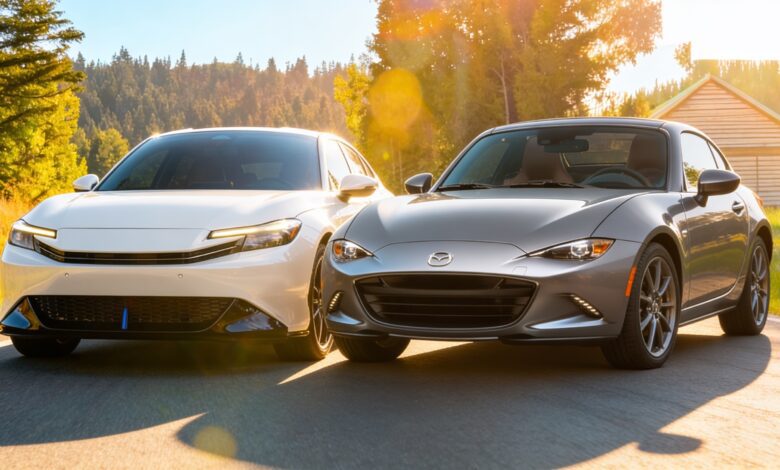
In 2026, the Spanish sports car market once again faces an intriguing choice: the Mazda MX-5 and the Honda Prelude offer two opposing takes on affordable driving pleasure. Both vehicles are formally part of the budget sports car segment, but their differences are so fundamental that the comparison becomes an analysis of two different philosophies. The Mazda MX-5 has long been established in Spain as the benchmark lightweight rear-wheel-drive roadster, while the Honda Prelude has just returned to the market, offering a fresh hybrid approach and a higher level of equipment.
Dimensions and practicality
The main distinction between these models is size and weight. The Mazda MX-5 is a compact two-seater roadster, 3.91 meters long and weighing just 1,130 kg. This format is ideal for those who value lightness and agility, as well as preferring the classic rear-wheel-drive layout. The Honda Prelude, on the other hand, is noticeably larger: 4.52 meters long, nearly 1.88 meters wide, and weighing about 1,470 kg. This is closer to the format of a full-fledged coupe, designed for more comfortable journeys and enhanced features.
Practicality is not a priority for either model, but the Prelude offers a 264-liter trunk — more than the MX-5, which is limited to just 127 liters. The difference is not critical for daily tasks, but for longer road trips or short getaways, Honda’s advantage becomes more apparent.
Technology and engines
The technical details highlight the difference in approaches. The Mazda MX-5 remains true to tradition: a 1.5 Skyactiv-G petrol engine with 132 hp, rear-wheel drive, and a six-speed manual transmission. This setup accelerates from 0 to 100 km/h in 8.3 seconds and reaches a top speed of 204 km/h. Fuel consumption is 6.3 l/100 km, and CO2 emissions are 142 g/km. A more powerful 184 hp version was previously available but has now disappeared from the brand’s configurator.
The Honda Prelude focuses on hybrid technology: it features a 2.0-liter petrol engine paired with an electric motor, delivering a combined output of 184 hp and 315 Nm of torque. It comes with front-wheel drive and an automatic transmission. Acceleration to 100 km/h takes 8.2 seconds, with a top speed of 188 km/h. The Prelude is more economical: consumption of 5.2 l/100 km and CO2 emissions at 117 g/km. Thanks to its hybrid setup, the model receives an ECO environmental label, which is a plus for city driving, but raises concerns among purist driving enthusiasts.
Equipment and Pricing
In its base Prime-Line trim, the Mazda MX-5 offers 16-inch alloy wheels, fabric upholstery, air conditioning, wireless Android Auto and Apple CarPlay, LED headlights, navigation, lane-keeping assist, and a six-speaker audio system. The Honda Prelude Advance goes further: 19-inch wheels, synthetic leather, adaptive cruise control, premium BOSE audio, digital instrument cluster, heated seats, an expanded set of driver aids, and a wide range of modern features.
The price gap between the models is significant. The Mazda MX-5 soft top version starts at €33,080, while the RF variant is priced from €35,580. The Honda Prelude is noticeably more expensive, with a base price of €49,500. The €16,000 difference not only allows you to choose the MX-5 but also purchase an inexpensive city car for everyday needs.
Market context and choice
Both models are aimed at enthusiasts for whom driving emotions matter more than pragmatism. However, if the goal is to get the most enjoyment for the least money, the Mazda MX-5 looks preferable. It is lighter, more dynamic on the road, offers classic manual transmission, and a higher top speed. The Prelude wins in terms of features and efficiency, but its hybrid setup and automatic gearbox may not appeal to fans of a pure sports character.
Interestingly, such comparisons are becoming more relevant as new hybrid and electric models enter the sports segment. For example, a station wagon with a hybrid powertrain producing 639 hp recently debuted on the market, sparking heated discussions among fans of fast family cars—you can read more about this in the article about the unexpected approach of the Audi RS 5 Avant 2026.
For the Spanish market, the Mazda MX-5 remains one of the few affordable options for those seeking a lightweight, honest sports car without excessive electronics. The Honda Prelude, on the other hand, is aimed at buyers who value modern technology, comfort, and the status of a new release. The final choice depends on personal priorities: driving engagement and manual transmission, or comfort and hybrid efficiency.