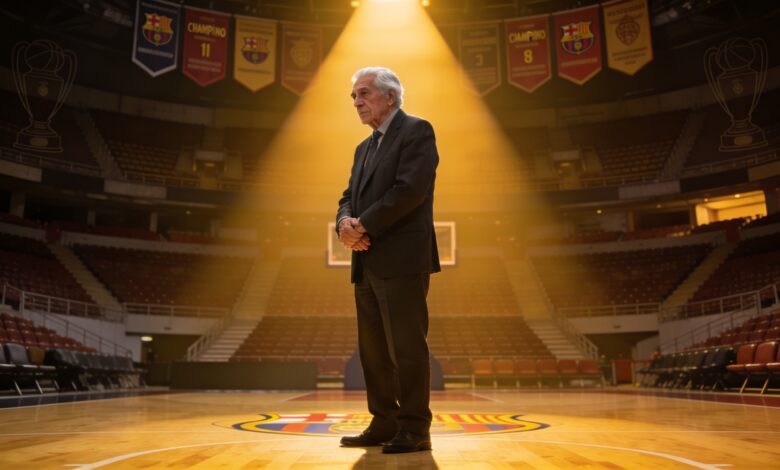
Spanish basketball has suffered a loss: at the age of 81, Moncho Monsalve has passed away, a man who shaped the development of the game in the country since the 1960s. His name is inseparably linked with Real Madrid, where he was part of the club’s first great team, as well as with the national team, for which he played 65 games. Monsalve was not only an outstanding player, but also one of those who laid the foundation for the modern coaching school in Spain.
The Path to the Top
Born in Medina del Campo and having made San Sebastián his second home, Moncho Monsalve entered basketball thanks to his meeting with Antonio Díaz Miguel and Xabier Añua during the San Fermines festival in 1962. Just a year later, he joined Real Madrid, where in four seasons he won nine titles, including three European Cups, three national championships and three Spanish Cups. His height and passion for the game quickly made him a standout on the court, and his move from Atlético San Sebastián became the starting point for his rapid rise.
Injury and a New Role
In 1972, Monsalve was forced to end his playing career due to a chronic knee injury. However, even then he was preparing for a coaching path, training in Barcelona alongside figures such as Pepe Laso and María Planas. His transition to the coaching bench proved equally significant: he led teams from various regions — from Mataró to Zaragoza, Murcia, Málaga, Ferrol, Hospitalet, Basket Mestre, Oximesa Granada, Náutico Tenerife, Castilla Valladolid, Cantabria Lobos and Balneario de Archena. In addition, Monsalve worked with the national teams of Morocco, the Dominican Republic and Brazil, and also held positions in the Spanish Basketball Federation and contributed as a media analyst.
Contribution to the Development of Basketball
Monsalve’s contribution to the development of coaching methodology has been recognized not only by his peers but also through official awards. In 2010, he received the Raimundo Saporta Award from the Spanish Coaches Association, and in 2024, he was inducted into the Spanish Basketball Hall of Fame. Monsalve himself emphasized that his approach was based on a unique system of explaining tactics: he preferred to work with players through words, not just diagrams on a board, aiming to convey the essence of his ideas to each individual. His admission that he always wanted to be a coach is supported by the fact that, even as a player, he completed the highest-level coaching course.
Legend and legacy
The story of Monsalve is not just a sequence of titles and teams, but also an example of how a chance encounter can change a life. He was discovered at San Fermines, after which he received a scholarship and ended up in Madrid, where he lived next to Dúo Dinámico. Even in his youth he was known as a promising track and field athlete, but basketball became his true calling. Recalling the start of his career, Monsalve spoke about being invited to join Real Madrid before he had even turned 18.
Moncho Monsalve’s impact on Spanish sports rivals that of other iconic figures who have shaped entire generations. His approach to teaching and his passion for the game remain examples for young coaches and players. In this context, it is interesting to note that the influence of family and mentors on an athlete’s career is often decisive—as illustrated by the story of an artist from Ibiza who shared his experience and the support of his loved ones in the article about the influence of family on a sports career.