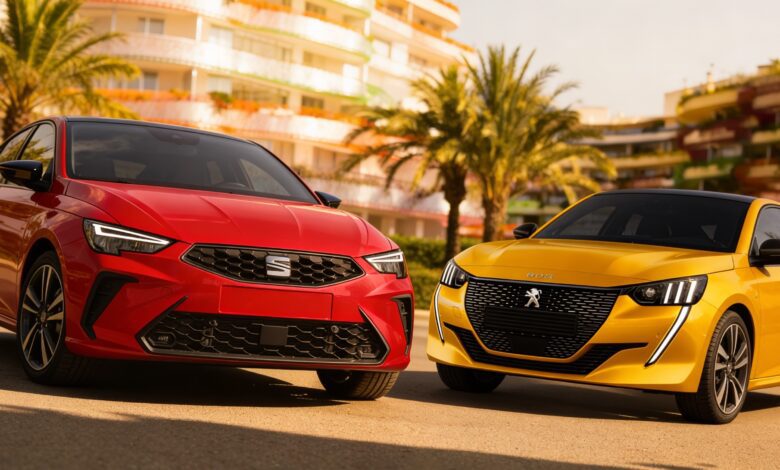
In 2026, the compact hatchback market in Spain is experiencing unprecedented competition, with the Seat Ibiza and Peugeot 208 taking center stage. Both cars have long secured top sales positions despite the dominance of SUVs, and continue to attract buyers thanks to their balanced combination of price, equipment, and suitability for both city and highway use. While the Seat Ibiza focuses on classic practicality and affordability, the Peugeot 208 responds with a wide range of engines, including electrified versions, which are increasingly relevant for Spanish cities.
Dimensions and trunk capacity
In terms of size, the Seat Ibiza and Peugeot 208 are almost identical: both fit into the 4-meter segment, making them ideal for urban environments. However, trunk space is a key argument in favor of the Spanish model. The Seat Ibiza offers a luggage compartment volume of 355 liters—one of the best in its class—making it easy to set off on a trip with family or load your shopping. The Peugeot 208, by contrast, provides only 208 liters, which significantly limits its versatility and may become a decisive factor for many buyers.
Engines and environmental performance
The main difference between the models lies in their approach to powertrains. The Seat Ibiza in 2026 still relies exclusively on gasoline engines, with no hybrid or electric versions. The base 1.0 MPI with 80 hp and a manual transmission is an option for those seeking minimum costs, though both performance and efficiency are fairly modest here. The 1.0 TSI with 115 hp, available with a manual or DSG, appears more balanced, while the top-end 1.5 TSI with 150 hp is for those who value performance but are willing to pay more. All Ibiza versions receive only the C environmental badge, which, given stricter urban regulations in Spain, is becoming an increasingly significant drawback.
Peugeot 208, on the other hand, offers not only gasoline engines (from 100 to 145 hp) but also mild-hybrid versions with the ECO badge, as well as full electric vehicles. The electric 208 is available in two versions: 136 and 156 hp, with a range of up to 433 km, while the flagship E-208 GTI with 280 hp emphasizes the sporty character of the lineup. This approach allows the French model to appeal to several categories of buyers at once—from those seeking savings to those looking to completely move away from internal combustion engines.
Price and equipment
When it comes to pricing, the Seat Ibiza retains its leadership: the starting price is €15,390, making it one of the most affordable options in the segment. The Peugeot 208 starts at €17,760, and while the difference does not seem critical, for the average buyer it may be decisive. At the same time, the base versions of both models already include a solid set of features. The Ibiza+ offers LED headlights, a digital instrument cluster, multimedia with Android Auto and Apple CarPlay support, as well as modern safety systems. The Peugeot 208 in the Style version is equipped with ECO LED headlights, an analog instrument panel with a TFT screen, climate control, and an extended set of airbags.
Market and choice
The choice between the Seat Ibiza and Peugeot 208 in 2026 is not just a matter of preference, but a reflection of Spanish buyers’ priorities. The Ibiza wins out thanks to its practicality and price, remaining one of the few truly family-friendly options in the segment. However, the absence of hybrid and electric versions limits its prospects as environmental regulations become stricter. The Peugeot 208, on the other hand, sacrifices trunk space, but compensates with a wide range of engines and the option to choose an electrified version, which is especially important for residents of large cities and those already considering future restrictions on internal combustion engines.
Interestingly, such competition and balance of strengths and weaknesses are characteristic not only of the compact hatchback market. Other segments of the Spanish car fleet also witness sharp confrontations between traditional and innovative solutions, as was recently discussed in the article about the internal conflict at Real Madrid — an analysis of hidden contradictions and unexpected twists within the team. Spain’s automotive market today is just as multilayered and unpredictable as football passions: there are no clear winners here, and the choice always depends on nuances and personal priorities.
Seat Ibiza and Peugeot 208 represent two different approaches to the same segment, and both continue to shape the look of Spanish roads. For those who value spaciousness and affordability, the Ibiza remains a rational choice. For those looking toward electrification and willing to accept a smaller trunk, the 208 offers more flexibility and possibilities. In any case, both cars reflect the main trends and challenges of the Spanish market in 2026.