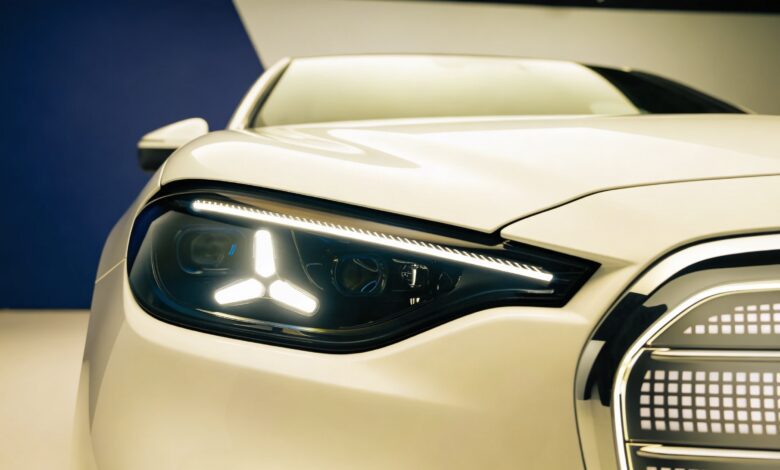
The 2026 Mercedes-Benz Clase C has been officially unveiled with a grille that immediately sets the model apart from its competitors: 1,050 individually illuminated points create a distinctive light signature. This approach not only underscores the brand’s visual identity but also demonstrates how far Mercedes is willing to go in integrating digital technologies into mass-market models.
A lighting revolution in the segment
For the first time, such a complex LED structure appears not on the flagship, but specifically on the Clase C—a model traditionally aimed at mass buyers in Spain. Each of the 1,050 elements is laser-cut and equipped with its own fiber optic illumination, allowing for dynamic lighting scenarios: greeting, farewell, and even abstract animations. At night, the effect is amplified—the grille resembles a floating three-dimensional surface, and the pattern of miniature three-pointed stars references the Mercedes emblem in a modern interpretation.
Technologies and sensor integration
An important engineering detail: behind the complex lighting structure are concealed radars and sensors of driver assistance systems. They are now fully integrated into the design without the usual plastic inserts, which improves visual integrity and aerodynamics. This solution has optimized cooling: airflow through the grille is now more efficient, which is particularly important for hybrid and electrified versions. The new Clase C generation comes equipped with a Level Two Plus autonomous driving system, where the precision of sensor operation has a direct impact on safety and comfort.
Digital cabin and artificial intelligence
Inside, the 2026 Clase C continues the drive towards digitalization: the interface has been completely redesigned, controls have become more intuitive, and artificial intelligence analyzes the driver’s habits and offers quick access to necessary functions. The visual concept of the cabin echoes the exterior light show—illumination and design create the sense of a unified space, where every detail contributes to an overall impression of advanced technology.
Electrification and market context
The 2026 C-Class engine lineup features only electrified versions: 48-volt mild hybrids and new plug-in hybrids with an electric driving range of over 120 km according to WLTP. This allows the car to be used as a fully electric vehicle in the city, while retaining the ability for long-distance travel with the internal combustion engine. The electronic architecture optimizes energy recuperation by using traffic and route topography data. This approach reflects Mercedes’ strategy for a gradual transition to full electrification, which is especially relevant for the Spanish market, where demand for hybrids and electric vehicles continues to grow steadily.
Details for the Spanish market
The C-Class has traditionally held a strong position among midsize sedans in Spain, competing with the BMW 3 Series and Audi A4. The new generation, with its focus on lighting design and digital technologies, could further strengthen Mercedes’ position in a segment where buyers are increasingly seeking cars with distinct character and advanced assistance systems. Importantly, even complex features like the LED grille are now available not only in premium trims, but also in mainstream versions.
Interestingly, Mercedes is not the only brand betting on unexpected features in mainstream models. For example, Porsche recently surprised fans with an automatic roof on the 911 GT3 S/C — you can read more about the design details in the article about the technical features of the new GT3 S/C.
The 2026 Mercedes-Benz C-Class with its new illuminated grille is an example of how, even in the mass market segment, brands are ready to introduce features that until recently seemed reserved for concept and show cars. For the Spanish market, this is not only a matter of image but also a tangible step toward a digital future, where every detail of the car becomes part of the communication between the vehicle, the driver, and the world around them.