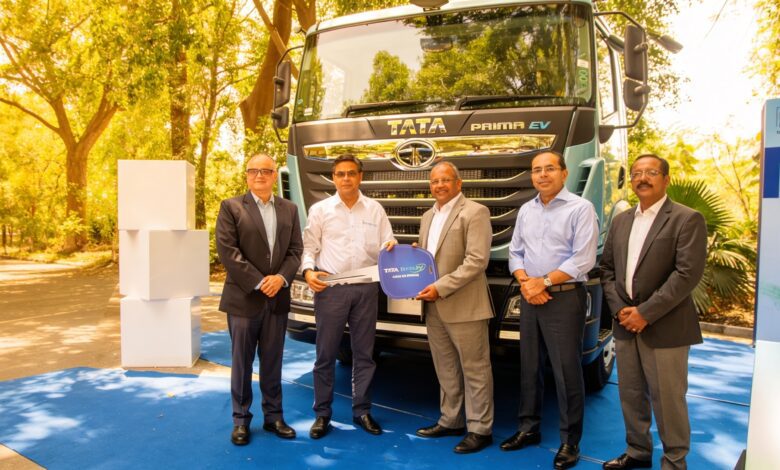
The electrification of heavy transport continues to gain momentum, and a new major order for the Tata Prima E.55S confirms: even in the long-haul truck segment, real alternatives to diesel are emerging. Tata Motors, which owns Jaguar and Land Rover, has signed an agreement with India’s BillionE Mobility to supply 250 Prima E.55S electric tractors. This is not just another batch—this model is designed to carry up to 55 tons, taking electric tractors to a new level in the industry.
The Prima E.55S is built on the i-MoEV platform, specifically developed for commercial electric vehicles. Its design incorporates an integrated electric axle (e-axle) and a regenerative braking system, increasing efficiency on long routes. A key feature is the 450 kWh battery, the largest in its class according to Tata Motors. This energy reserve provides up to 350 km of range on a single charge, making the model competitive for interregional transport, though infrastructure limitations remain a serious challenge.
Technology and Operation
These 250 electric trucks will operate on India’s main logistics corridors, including the states of Gujarat, Rajasthan, Tamil Nadu, Karnataka, Maharashtra, as well as the Delhi NCR and Haryana regions. The primary task is long-distance transport of industrial freight such as steel and cement. For such conditions, not only range but also reliability is crucial: the Prima E.55S is equipped with a three-speed automatic transmission, a fast-charging system with dual connectors (dual-gun), as well as a range of electronic assistants — from cruise control to tire pressure monitoring and driver fatigue detection.
Inside the cab, Tata Motors engineers focused on ergonomics and driver comfort, which is especially important for intensive use on long routes. Options include advanced assistance systems and the ability to integrate additional safety features. This approach reflects Tata Motors’ strategy for the development of commercial electric vehicles, where, alongside electric drives, the company continues working with alternative technologies — from gas to hydrogen.
Market and prospects
The order for 250 vehicles is only part of BillionE Mobility’s large-scale plan: the company aims to expand its fleet of heavy electric trucks to 1,500 units within the next 6–18 months. This is an ambitious bet on the electrification of commercial transport, a sector still dominated by diesel. Importantly, the plan covers not only vehicle procurement but also the development of charging infrastructure and digital fleet management solutions—an essential prerequisite for the large-scale adoption of electric trucks.
However, even with such technological breakthroughs, key barriers remain. A range of 350 km is a significant step forward, but for many routes this is not enough without a well-developed network of charging stations. Charging times, despite rapid systems, are still slower than traditional diesel refueling, which affects logistics and transport economics. In addition, the high cost of electric vehicles requires operators to carefully calculate return on investment, weighing not only fuel and maintenance savings but also potential government incentives.
Context for Spain
Although the Tata Prima E.55S has not yet been announced for the European or Spanish market, the very fact that such a heavy electric tractor with real range and industrial positioning has emerged is significant for the entire industry. In Spain, the electric truck segment is only beginning to take shape, and the experience of the Indian market might serve as a reference point for local operators and manufacturers. This is especially relevant given that European brands are still cautious about the mass launch of high-capacity electric trucks.
In this context, it is interesting to compare Tata Motors’ strategy with the approach of other manufacturers who are betting on hybrid solutions. For example, Honda recently presented the 2026 Prelude coupe with a hybrid powertrain, which also reflects the trend toward balancing traditional and alternative technologies. You can read more about the return of the iconic Honda model in the article about the new hybrid Prelude 2026.
For the Spanish market, the emergence of models like the Tata Prima E.55S signals that the electrification of heavy transport is becoming not just a technological experiment, but a commercial reality. In the coming years, it will be the experience of major logistics operators and manufacturers that determines how quickly electric tractors can secure their place on European roads.