Moments that spark years-long discussions are rare in the British royal family. Yet this was the case with the marriage of Charles III and Camilla: their 2005 wedding is still remembered not only because of the couple, but also due to those who did not attend. The absence of Elizabeth II and the Duke of Edinburgh at the ceremony became one of the most talked-about details of that day—sparking a wave of theories, rumors, and speculation.
A Wedding Without the Queen
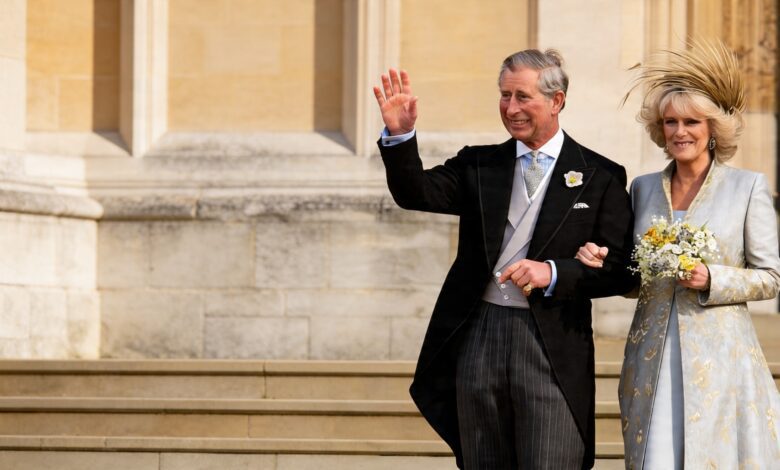
The story of Charles and Camilla has long been a fixture in the British social chronicle. Their relationship began as early as 1970, but only decades later, after divorcing their previous spouses, could the couple officially formalize their feelings. On April 9, 2005, Charles and Camilla exchanged vows at Windsor Guildhall, opting for an extremely modest setting: just 28 guests, without grand processions or global television coverage. Against the backdrop of Charles’s lavish 1981 wedding to Princess Diana, this event seemed almost intimate.
But it was precisely the absence of the Queen and her husband that became the main topic of discussion. The official version from Buckingham Palace was reserved: the groom’s parents wished for the celebration to be held in a small, private circle. However, the British public immediately offered other explanations. Many believed the Queen could not publicly support a union long regarded as controversial due to the history between Charles and Camilla during his marriage to Diana. After Diana’s death in 1997, some subjects saw Charles’s new marriage as a sign of disrespect to her memory.
The question of faith and symbols
Another cause for discussion was the religious aspect of the matter. As head of the Anglican Church, Elizabeth II found herself in a difficult position: to support her son, but not break with tradition. According to biographer Robert Hardman, her decision not to attend the civil ceremony was more a sign of disapproval of the format than of the marriage itself. Nevertheless, after the official part, the Queen and the Duke of Edinburgh hosted a reception for the newlyweds at Windsor Castle and participated in the religious blessing at St George’s Chapel. Many saw this gesture as an expression of approval of the union, despite all the controversies.
Interestingly, the wedding of Charles and Camilla was postponed by a day because the prince had to attend the funeral of Pope John Paul II. This caused quite a stir: souvenir dates had to be changed, and television channels urgently adjusted their broadcast schedules. As a result, the ceremony did not overlap with another high-profile wedding — that of characters from the series Coronation Street, which attracted twice as many viewers.
Gestures That Are Not Forgotten
On the day of the reception for the newlyweds, Elizabeth II appeared in a white outfit — a color traditionally chosen by the bride. This choice immediately sparked fresh interpretations: some saw it as a subtle hint, others — as an attempt to support Camilla, who had chosen a blue dress. Rumors about hidden meanings only fueled public interest in the event.
During the reception, the Queen gave a speech, comparing her son’s love story to the horse races held on the same day. She noted that the couple had overcome many obstacles and were finally together. That evening, Charles and Camilla received the titles of Duke and Duchess of Cornwall, and a year before her death, Elizabeth II officially expressed her support for Camilla as the future queen consort.
Family Decisions and Public Reactions
There was much discussion surrounding the wedding of Charles and Camilla about how much the Queen genuinely supported this union. Grant Harrold, Prince Charles’s former butler who was among the guests, claimed that Elizabeth II looked truly happy that day. A palace spokesperson also emphasized that her absence from the ceremony was not a sign of coldness; rather, her participation in the religious blessing and hosting the reception was a clear sign of approval.
Family stories and unexpected decisions by monarchs always attract public interest. Just as with other famous couples, for example, the split between Paz Vega and Orson Salazar, which also became the subject of discussions and insinuations on social media — details of this story can be found here. In the case of Charles and Camilla, every gesture, choice of outfit, or public word from the Queen became grounds for new theories and discussions.
Today, 21 years after the wedding, the couple remains in the spotlight, and that very day in Windsor serves as an example of how, even in the most private families, public gestures and details can become part of the broader social chronicle.