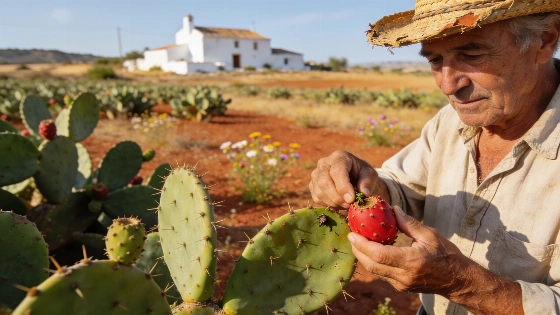
Once a common sight along rural paths, prickly pears nearly vanished from Andalusia. Now, a 63-year-old farmer in Chiclana is rebuilding one of the region’s largest plantations, supplying local markets and facing down a persistent pest threatening the crop’s survival.
On the outskirts of Chiclana de la Frontera, Paco Benítez, 63, is quietly leading a revival. His family plot in El Marquesado, covering nearly 8,000 square meters, is now home to one of Cádiz province’s largest prickly pear plantations—a crop that, until recently, had all but disappeared from the Andalusian landscape.
Benítez’s connection to the land runs deep. He left school at 13 to work in agriculture, later moving into construction to make ends meet. Yet, even as he built houses, he never abandoned the fields, tending vines and vegetables whenever he could. In 2011, he planted a row of prickly pear cacti to shield his vines from the relentless Levante wind. The experiment lingered in his mind, and by 2022, he had replaced old grapevines with rows of chumberas, expanding the plantation using cuttings from his own plants.
Fighting for Survival
Each harvest brings a new battle. The carmine cochineal, an insect known as Dactylopius opuntiae, has devastated prickly pear crops across southern Spain. The pest attaches itself to the cacti, often killing the plant before visible damage appears. Benítez spends countless hours monitoring his fields, treating infected plants before the infestation can spread. According to the Junta de Andalucía, unchecked outbreaks can wipe out entire plantations, making vigilance essential.
Despite the crop’s natural resistance to drought, the constant threat of the cochineal has turned what was once a low-maintenance fruit into a labor-intensive gamble. “You can lose a whole season if you’re not careful,” Benítez explains. The challenge is not unique to him; across Spain, farmers have faced similar struggles, as highlighted in cases where agricultural work and retirement rules have collided, such as a recent court decision involving a retired farmer in La Rioja who was ordered to repay benefits for continuing to manage his land (see more on the legal complexities facing Spanish farmers).
From Abundance to Scarcity
For decades, prickly pears grew wild along roadsides and property lines, free for the taking. Their abundance meant few saw commercial value in the fruit. But as the cochineal spread and old plants died off, the once-ubiquitous cactus became a rarity. Today, Benítez’s harvest is in demand at local markets, fruit shops, and wholesalers. The scarcity has even prompted other farmers to try their hand at reviving the crop, using cuttings from surviving plants or sourcing new ones where possible.
A Crop with Deep Roots
The return of the prickly pear is more than a personal project for Benítez. It’s a restoration of a crop woven into Andalusia’s rural identity for centuries. The cactus thrives in poor, dry soils where few other crops survive, offering a potential lifeline for marginal land—if the pest can be kept at bay. As Benítez’s experience shows, the future of the prickly pear in southern Spain will depend on a mix of tradition, innovation, and relentless attention to the threats that nearly erased it from the landscape.