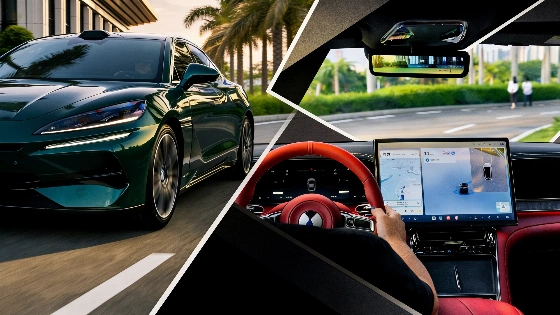
BYD’s Denza Z9GT, equipped with the ‘God’s Eye 5.0’ system, is redefining what’s possible for autonomous vehicles. Tested in the dense traffic of Shenzhen, this AI-driven technology learns from millions of real-world kilometers and is already outpacing European rivals.
In the heart of Shenzhen’s relentless traffic, the Denza Z9GT—a luxury model from BYD—demonstrates what the future of autonomous driving looks like. Outfitted with the ‘God’s Eye 5.0’ system, this vehicle is the first in China to receive a national license for Level 3 autonomous driving trials, marking a significant leap ahead of European competitors.
Unlike traditional systems that rely on rigid programming, ‘God’s Eye 5.0’ is built on an end-to-end artificial intelligence model enhanced by reinforcement learning. This means the car doesn’t just follow pre-set instructions; it continuously adapts, making decisions that increasingly resemble human judgment. The system’s evolution is fueled by data from over 2.65 million BYD vehicles in China, which collectively cover more than 160 million kilometers every day. Each journey feeds real-world scenarios back into the AI, allowing it to refine its responses to complex traffic situations.
Technologically, the Denza Z9GT is equipped with a sophisticated array of sensors. High-precision LiDAR maps the environment in 3D, even creating virtual lanes when road markings are absent. HD cameras and millimeter-wave radars work together to detect obstacles, pedestrians, and other vehicles, ensuring the system can react instantly to unpredictable conditions. For added safety, high-end models feature hardware redundancy in steering, braking, and propulsion, so the car remains under control even if a component fails.
Activating the autonomous mode is straightforward: a tap on the left paddle triggers blue lights on the mirrors and rear, signaling to others that the vehicle is driving itself—a legal requirement in China. However, regulations still mandate that the driver must keep at least one hand in contact with the steering wheel to maintain access to the system.
During real-world testing, the Denza Z9GT navigated the chaos of Shenzhen with remarkable composure. The system handled sudden lane changes, U-turns, roundabouts, traffic lights, overtaking, and even construction detours—adapting seamlessly to muddy or snowy roads. If a route was blocked, the AI quickly recalculated and found an alternative. The car’s ability to execute complex maneuvers, such as drifting without driver intervention, highlights just how advanced the technology has become.
BYD’s commitment to pushing boundaries is evident in its investment of over €12 billion to further develop autonomous capabilities. The company employs 5,000 engineers dedicated to refining the system, and it now offers a one-year comprehensive damage guarantee for vehicles using ‘God’s Eye 5.0’—a bold statement of confidence in its technology.
China’s rapid progress in electric and autonomous vehicles is drawing attention across the industry. For those interested in how BYD’s broader lineup is challenging established brands in Europe, a closer look at the Atto 2’s range and features can be found in this detailed comparison of BYD’s Atto 2 with its European rivals.
As the global race for autonomous driving leadership accelerates, BYD’s ‘God’s Eye 5.0’ stands out not just for its technical prowess, but for its ability to learn and adapt at scale. With millions of kilometers of real-world data and a clear focus on safety, the company is setting a new benchmark for what drivers can expect from the next generation of intelligent vehicles.