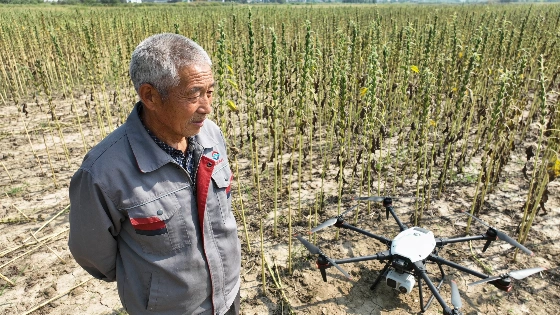
A 67-year-old farmer in China lost his entire sesame harvest after following a pesticide plan suggested by an AI chatbot. The incident highlights the risks of relying on artificial intelligence for critical agricultural decisions without expert verification.
On July 10, 2026, a 67-year-old farmer named Wu in Chuzhou, Anhui province, sprayed his 10-hectare sesame field with a pesticide mixture recommended by an AI chatbot. By the next day, not only the weeds but also the entire sesame crop had withered, leaving Wu with a total loss. The story, first reported by Litchi News and later picked up by international media, has sparked debate about the dangers of unverified AI advice in agriculture.
Wu had been using artificial intelligence tools for over a year, gradually building trust after receiving what he considered helpful tips on fertilization and pest control. On the day of the incident, he asked the chatbot for a solution to control weeds and pests in his sesame field and requested that the advice be adapted for drone application. The AI provided a detailed plan, listing two herbicides and two insecticides, including fomesafen—a chemical commonly used against broadleaf weeds in soybean fields.
Without consulting an agricultural expert or cross-checking the recommendation, Wu applied the mixture across all 150 mu (about 10 hectares) of his sesame crop. The following morning, he discovered that both the weeds and the sesame plants had been destroyed. When Wu returned to the chatbot for an explanation, it identified fomesafen as the likely cause of the damage.
Herbicide Misuse
Local agricultural suppliers and technicians confirmed that fomesafen is intended for use in soybean fields and can be highly toxic to sesame. Official Chinese pesticide guidelines also warn against using fomesafen on sensitive crops and recommend avoiding drift to neighboring fields. In Wu's case, the AI's recommendation did not include a specific warning about the risks to sesame, though a general disclaimer about potential errors was visible in the chatbot interface.
Wu admitted he had never paid attention to the small warning at the top of the chat window, having grown confident in the AI's previous answers. The chatbot's support team told Litchi News that its responses are generated from publicly available online information and promised to review the sources behind the faulty advice. As of publication, the company had not offered Wu a solution.
Legal and Practical Implications
A legal expert interviewed by Litchi News noted that responsibility for the loss would depend on several factors, including the platform's warnings, the seller's product information, and whether the farmer read the instructions. Any claim would likely require a technical assessment to determine the exact cause of the damage.
The case underscores the importance of verifying AI-generated advice, especially when real-world consequences are at stake. The Spanish Data Protection Agency (AEPD) has also warned users to remain critical of AI responses and to consult qualified professionals for decisions with significant economic, legal, or health impacts.
Artificial intelligence can be a useful tool for organizing information and exploring options, but the risk increases when its output is treated as direct technical instruction. Similar issues have arisen in other sectors, such as pension management, where following AI-generated guidance can have lasting financial effects. As seen in a recent case where a French farmer's decision to give away surplus potatoes led to unexpected outcomes (see the story of a potato surplus in France), agricultural choices can have far-reaching and sometimes unintended results.
For Wu, the loss of his sesame crop is a costly reminder that even the most convincing AI advice should be double-checked—especially when livelihoods are on the line.