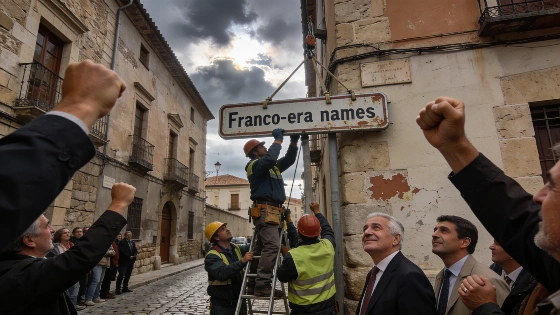
A regional court has instructed Ciudad Real to reinstate five street names linked to the Franco era. The decision partially overturns changes made under Spain’s historical memory law. Political tensions have resurfaced in the city.
The Superior Court of Justice of Castilla-La Mancha has ruled that the Ayuntamiento de Ciudad Real must restore the original names of five streets that were changed in 2021 to comply with Spain’s historical memory law. The court found that the individuals commemorated by these street names did not play an active or significant role in the military uprising, the Civil War, or the subsequent dictatorship, and therefore their names should not have been removed.
This decision comes after a legal challenge by Luis Juan Blázquez, former city councillor and provincial president of Vox, who contested the city council’s 2021 resolution to rename nine streets referencing figures or events from the Civil War and Francoist period. The court’s ruling affects only five streets named after individuals, while upholding the changes for four others that referenced battles or locations, which the judges considered clear cases of glorifying the Civil War.
The five streets set to revert to their previous names are Pasaje Gutiérrez Ortega, calle José María Aparicio Arce, calle Gregorio Sánchez-Puerta, Plaza de Fernando Merry del Val y García Zapata, and the group of viviendas Vicente Galiana. These had been renamed as Pasaje de la Pandorga, Manuel Herrera Piña, Irene Villa, Plaza Gloria Fuertes, and grupo Adolfo Suárez, respectively. The court determined that holding a position or being affiliated with a particular party during the Franco era does not, by itself, justify the removal of a street name under the law.
The ruling draws on Supreme Court jurisprudence, emphasizing that only a clear link between a person and support for the uprising or dictatorship warrants such measures. The judges noted that brief biographical references are insufficient grounds for action under Article 15.1 of the historical memory law. They also referenced a 2025 Supreme Court decision that required Madrid to restore plaques for Largo Caballero and Indalecio Prieto, arguing that historical context must be applied consistently.
The original changes in Ciudad Real were based on recommendations from the now-defunct Mesa de la Memoria Histórica, a committee of experts and officials. According to this group, several of the individuals whose names are to be restored were prominent Falangists or held significant roles in the Franco regime. However, the court found no evidence of direct involvement in the uprising or repression, and thus ruled in favor of reinstating their names.
Political reactions have been swift. The Partido Popular, which currently governs Ciudad Real after ending its coalition with Vox, has criticized the previous Socialist administration for what it calls a partisan approach. Former mayor Pilar Zamora, now a senator for the PSOE, has urged the city to appeal the decision, arguing that honoring those who defended democracy should not be seen as political bias.
Historians involved in the original renaming process maintain that the restored names are closely tied to the Francoist past, particularly the early fascist phase. Isidro Sánchez, a historian and former member of the Mesa de la Memoria Histórica, described the ruling as a step backward, highlighting the ideological backgrounds of the individuals in question. He pointed out that some, like Gutiérrez Ortega, were known for their hardline positions and public statements supporting repression during the dictatorship.
The debate in Ciudad Real reflects broader tensions in Spain over how to address the legacy of the Civil War and Francoism. Similar disputes have arisen in other cities, such as Madrid, where legal battles over historical memory measures have drawn national attention. For example, a recent case in the capital saw the courts halt the eviction of an elderly tenant, highlighting the ongoing intersection of legal decisions and local policy as reported in a related Madrid housing dispute.
Spain’s Law of Historical Memory, enacted in 2007, aims to recognize victims of the Civil War and dictatorship and remove public symbols that glorify the regime. However, its application remains contentious, with courts often called upon to interpret the law’s requirements. The Ciudad Real case underscores the complexity of balancing legal standards, historical interpretation, and local politics in the ongoing debate over Spain’s past.