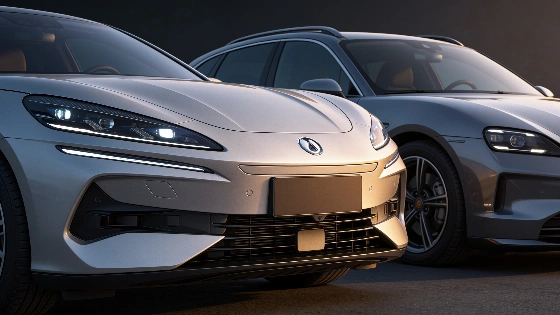
The Denza Z9GT arrives from China to take on the Porsche Taycan, promising luxury, performance, and advanced tech. But can the newcomer truly rival the established German icon in the premium electric segment?
When Denza, the Chinese brand backed by BYD, unveiled the Z9GT, it was clear the target was not just any electric sedan, but the Porsche Taycan itself. This direct challenge signals a shift: Chinese manufacturers are no longer content to compete on price alone, but are now aiming for the heart of Europe’s luxury automotive market with their own technology and design.
Both the Denza Z9GT and Porsche Taycan are positioned as high-performance luxury sedans, but their approaches diverge in key areas. The Z9GT is physically larger, measuring 5,180 mm in length for the electric version and stretching to 5,195 mm for the plug-in hybrid DM-i, with a wheelbase of 3,125 mm. In contrast, the standard Taycan comes in at 4,963 mm long with a 2,900 mm wheelbase, though Porsche offers three body styles: sedan, Sport Turismo, and Cross Turismo, each with slight dimensional tweaks. Luggage space also favors the Denza, offering 478 liters versus the Taycan’s 446 liters.
Powertrains and Performance
The Denza Z9GT stands out for its versatility. The fully electric version uses three motors—one 230 kW unit up front and two 240 kW motors at the rear—delivering a 0-100 km/h sprint in 3.4 seconds. Its 100 kWh Blade Battery, based on LFP chemistry, claims up to 630 km of range under China’s CLTC standard. The DM-i plug-in hybrid variant combines a 152 kW petrol engine with three electric motors (one 200 kW front, two 220 kW rear), achieving 0-100 km/h in 3.6 seconds. Its smaller 38.5 kWh battery allows for 201 km of electric-only range and up to 1,101 km combined, according to CLTC.
Porsche’s Taycan, meanwhile, is exclusively electric but offers a broader range of powertrains. The entry-level Taycan delivers up to 408 hp and accelerates from 0 to 100 km/h in 4.8 seconds, with a WLTP range of up to 678 km. The Taycan 4 and 4S increase power and performance, while the GTS, Turbo, Turbo S, and Turbo GT push the envelope further—Turbo S reaches 952 hp and 0-100 km/h in just 2.4 seconds. Across the range, WLTP-certified ranges remain competitive, peaking at 678 km for certain versions.
Pricing and Value
Contrary to expectations, the Denza Z9GT is not the budget option. The electric Z9GT starts at €117,500, while the DM-i hybrid is priced from €103,500. The Porsche Taycan, in its standard sedan form, begins at €106,252, with the Sport Turismo and Cross Turismo variants costing slightly more. This pricing dynamic upends the assumption that Chinese luxury EVs will always undercut their European rivals.
Which One Wins?
The fact that Denza can credibly compete with Porsche on performance, technology, and even price marks a turning point for the industry. For buyers seeking a plug-in hybrid, the Z9GT DM-i is the clear choice, offering flexibility for those not ready to go fully electric. However, for those committed to pure electric driving, Porsche’s Taycan stands out for its range of body styles and powertrains, making it easier to find a model tailored to individual needs and preferences.
This evolving landscape is not unique to sedans. The electric SUV segment is also seeing fierce competition, as highlighted in a recent analysis of leading models from Skoda, Volkswagen, Hyundai, and Cupra, which are shaping the future of everyday electric mobility (see how these SUVs are setting new standards).
Context and Outlook
The arrival of the Denza Z9GT in Europe is more than a product launch—it’s a signal that Chinese brands are ready to challenge established players on their own terms. As battery technology, design, and performance continue to advance, the boundaries between traditional and new luxury automakers are blurring. For consumers, this means more choice, more innovation, and a rapidly changing definition of what it means to drive a premium electric car.