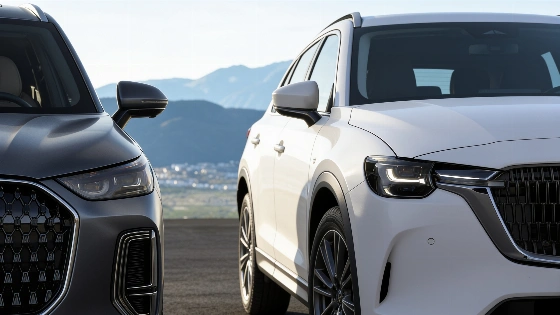
The Ebro S900 and Mazda CX-80 both offer seven seats and hybrid power, but their strengths diverge. One leads in electric range and value, the other in comfort and finish. Here’s how they compare for Spanish buyers.
Choosing between the Ebro S900 and Mazda CX-80 means weighing two distinct visions of the modern seven-seat SUV. The Ebro S900, Spain’s ambitious plug-in hybrid, promises up to 140 kilometers of electric range and a starting price of €42,590. The Mazda CX-80, meanwhile, enters the market with a premium feel, advanced safety, and a broader engine lineup, but at a significantly higher cost.
Space and Versatility
The Ebro S900 stretches 4.81 meters in length and offers a 2+3+2 seating layout as standard. Its interior is generous, with heated, ventilated, and electrically adjustable second-row seats that slide up to 26 centimeters for easier access to the third row—though those rear seats are best suited for children. Luggage space is tight with all seats in use (148 liters), but expands to 448 liters with five seats and a cavernous 2,065 liters when both rear rows are folded.
By contrast, the Mazda CX-80 is even larger at 4.99 meters long and boasts a 3.12-meter wheelbase. Buyers can choose between five or seven seats, with the second row available as either a three-person bench or two individual seats. The third row folds flat, and the boot offers 258 liters with all seats up, 687 liters in five-seat mode, and up to 1,221 liters with the rear rows stowed.
Technology and Comfort
Inside, the Ebro S900 is defined by its 15.6-inch central touchscreen, 10.25-inch digital instrument cluster, and an 8.8-inch head-up display projecting key driving data. The Luxury trim, the only version offered, includes wireless smartphone connectivity, voice control, navigation, a 540° panoramic camera, automatic Full LED headlights, and 26 advanced driver assistance systems, including smart parking.
The Mazda CX-80, however, raises the bar for interior quality. Materials and craftsmanship approach premium territory, with a 12.3-inch display, head-up display, tri-zone climate control, heated seats, and an eight-speaker audio system all standard. Mazda’s i-Activsense suite brings advanced safety features, such as Unresponsive Driver Support and enhanced emergency lane keeping, further distinguishing the CX-80 in terms of refinement and peace of mind.
Engines and Electric Range
The Ebro S900 is available exclusively as a plug-in hybrid, pairing a 1.5 TGDI petrol engine (44.5% thermal efficiency) with three electric motors—two up front, one at the rear—for a combined 425 hp and 580 Nm of torque. Acceleration from 0 to 100 km/h takes just 5.8 seconds. Its 34.46 kWh CATL battery enables up to 140 kilometers of electric driving (177 km in urban conditions), and supports fast charging at up to 71 kW DC, reaching 80% charge in 25 minutes. The V2L function allows the car to power external devices up to 6.6 kW.
The Mazda CX-80 offers more choice under the hood. The plug-in hybrid e-Skyactiv PHEV combines a four-cylinder petrol engine and electric motor for 321 hp and 500 Nm, with a 17.8 kWh battery delivering 60 kilometers of electric range. It charges at up to 7.2 kW AC, but lacks DC fast charging. Alternatively, the e-Skyactiv D mild hybrid diesel features a 3.3-liter inline-six and 48V system, producing 254 hp. Both engines are paired with an eight-speed automatic and all-wheel drive.
Price and Value
Price is a decisive factor. The Ebro S900 starts at €42,590, including financing and Spain’s Plan Auto+ incentives. The Mazda CX-80, with its higher level of finish and technology, begins at €62,571—a gap of nearly €20,000. For those who prioritize electric range and value, the Ebro S900 stands out. For buyers seeking premium comfort, advanced safety, and a diesel option for long-distance driving, the Mazda CX-80 justifies its higher price.
Market Context
Plug-in hybrid SUVs are gaining traction in Spain, with sales up 125% in 2025. The Ebro S900’s electric range is among the best in its class, making it a compelling choice for urban and suburban families. The Mazda CX-80, meanwhile, appeals to those who want a more refined experience and are willing to pay for it. For readers interested in how other hybrid SUVs stack up, a recent comparison of the Volvo XC40 and Alfa Romeo Tonale explores similar questions of value and technology in the Spanish market: see how these two models compare in the hybrid SUV segment.
Final Thoughts
The Ebro S900 and Mazda CX-80 represent two strong but different answers to the demand for spacious, electrified family SUVs in Spain. The Ebro’s unmatched electric range and competitive price make it a practical pick for those focused on efficiency and cost. The Mazda, with its superior comfort, craftsmanship, and diesel alternative, targets buyers who see their SUV as more than just a means of transport. As the Spanish market continues to embrace plug-in hybrids, these models highlight the evolving priorities of local drivers—balancing range, refinement, and real-world usability.