Fines up to €50,000: New Regulations for Restaurants and Cafés under Extreme Weather. New requirements for dining establishments have come into effect in Spain: owners are now obliged to protect employees from extreme weather conditions. Violations may result in fines up to €50,000. We explain what has changed and how businesses can avoid penalties.
With the arrival of summer, Spanish restaurants and cafés enter the high season — in every sense of the word. Terraces fill up, the flow of guests increases, and so does the pressure on staff, who are often forced to work under the open sun or in high temperatures. However, this year the rules of the industry have changed: caring for employees' safety in extreme weather conditions is now not just a recommendation, but a legal requirement. Violation of this obligation can cost businesses tens of thousands of euros.
New requirements
In April, the revised VI National Collective Labor Agreement for the hospitality sector (ALEH) was signed, resulting from an agreement between the FeSMC-UGT and CCOO Servicios unions and the employers' associations Hostelería de España and CEHAT. This document now takes into account modern climate risks and requires establishments not only to organize shifts and work processes, but also to be prepared in advance for possible extreme weather events.
Specifically, this concerns situations such as abnormal heat, floods, or heavy snowfall. Establishments are now required to have clear action protocols in place for such events to prevent harm to employee health.
Risk prevention plans
The updated regulations require that special measures to protect employees in extreme weather conditions be included in occupational risk prevention plans. This is not just a formality: these are concrete steps that must be specified and implemented before a dangerous situation arises. Improvising when an alert has already been declared is no longer considered acceptable.
The establishment owner is required to determine in advance how the staff will act in the event of heat, flooding, or snowfall, in order to minimize risks to health and life.
Shortening shifts and suspending work
If weather conditions become hazardous, employers are obliged to reduce working hours or even fully suspend operations. This is especially relevant during official danger warnings—for example, when an orange or red alert level is declared. In such cases, employee safety takes priority over serving guests.
This rule applies not only to indoor spaces but also to terraces, which traditionally generate the main revenue during the summer season.
Terraces and heat
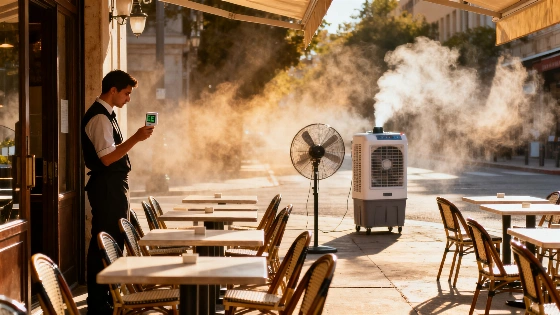
Working outdoors is a particular risk zone. The new regulations require cooling systems to be installed on terraces, ensuring acceptable working conditions for staff even during periods of extreme heat. There is no outright ban on working outdoors, but if proper safety measures are not in place, serving customers on the terrace during dangerous heat is prohibited.
For many establishments, this means the need to invest in equipment and reconsider how work is organized during the summer months.
Liability and fines
Failure to comply with the new requirements can result in significant financial losses. If an employer forces employees to work on a terrace during a red alert without proper protection, the fine can reach 50,000 euros. This constitutes a violation of the right to safe working conditions, and the authorities are now paying special attention to this issue.
A similar approach to tightening sanctions is already being applied in other areas: for example, fines for violations of waste management regulations were recently increased in Valencia, as detailed in the article on new fines for littering in the city streets.
What businesses should do
To avoid sanctions and ensure staff safety, establishments need to review their risk prevention plans in advance. It's important not only to formally develop protocols for extreme weather situations, but also to properly prepare equipment and procedures to reduce shifts or temporarily suspend operations. Particular attention should be paid to terraces: the presence of cooling systems and clear instructions for staff is becoming mandatory.
As a result, the new rules require businesses to be not only flexible, but also responsible. Now, caring for employees’ health is no longer just a matter of reputation, but a legal obligation, violations of which will result in substantial fines.