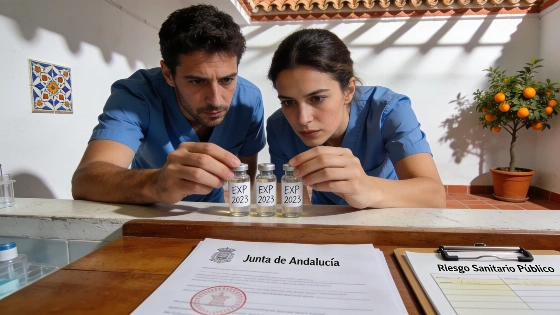
Prosecutors in Málaga are investigating claims that a public hospital in Axarquía used expired reagents in lab tests. The case began after a union complaint and could affect thousands of patients. Authorities have already submitted documents to the court.
The Málaga Prosecutor's Office has launched an investigation into allegations that a public hospital laboratory in the Axarquía region may have routinely used expired reagents for patient analyses. The inquiry follows a formal complaint from the CSIF union, which claims the practice could have put thousands of patients at risk and led to unreliable test results.
According to sources within the prosecutor's office, the first step has been to request detailed information from the hospital in Vélez-Málaga. The case centers on whether the reported actions could constitute a criminal offense or if the matter will ultimately be closed without charges. The Junta de Andalucía has confirmed that it has already provided the requested documentation, but officials have declined to release further details, citing the ongoing judicial process.
The union's complaint, filed in March, included extensive evidence: dozens of photographs, hundreds of WhatsApp messages, and supporting documents. CSIF alleges that the use of expired reagents was not an isolated incident but a regular practice in the hospital's laboratory. The union warns that such actions could lead to misdiagnoses or inappropriate treatments, as the lab equipment itself reportedly flagged the reagents as unreliable, yet staff were instructed to override these warnings and proceed with testing.
Further concerns raised by CSIF involve the falsification of labels—new stickers placed over old containers—and the reuse of packaging, which undermines traceability. Union representatives argue that these practices, allegedly ongoing since 2020, reflect an extreme cost-cutting approach and may have affected a significant number of patients. They also claim to have documented cases where intermediate managers authorized these irregularities, leading the union to request their temporary removal from duty as a precaution. In response, the two managers have filed a lawsuit against three CSIF delegates and the union itself, a case that remains active.
After initially presenting their findings to hospital management in January and following up in February, CSIF says their concerns were dismissed. The hospital's internal review reportedly concluded without consequences, prompting the union to escalate the matter to the regional government and, ultimately, to prosecutors. Their formal complaint includes over a hundred photos of expired reagents, evidence of machines being forced to accept them, around 3,000 WhatsApp messages, and testimonies from at least ten current or former laboratory staff.
CSIF also reports that technical staff have faced harassment since the issue became public. The union maintains that, while they do not claim to have the full truth, the documented irregularities pose a clear risk to patient safety and undermine confidence in the public health system. The Junta de Andalucía reiterates that all relevant documents have been submitted to the authorities and that no further information will be released while the case is under judicial review.
The controversy has drawn political attention as well. The PSOE has criticized the regional government's handling of the situation, arguing that public healthcare in Andalucía deserves better resources and safeguards. The case in Axarquía comes shortly after another incident at Hospital Clínico Virgen de la Victoria in Málaga, where a cleaning fluid contamination in blood analysis equipment led to 400 false positive results for occult blood in stool tests. In that case, technical staff detected the anomaly, identified the source, and patients were recalled for repeat testing. The administration described the event as a technical issue, not a systemic or procedural failure.
Similar to the current investigation, previous high-profile cases in Spain have highlighted the challenges of maintaining rigorous standards in public institutions. For example, a recent court ruling in Madrid exposed irregularities in public contracting, underscoring the importance of oversight and accountability in the public sector.
In Spain, laboratory reagents are subject to strict regulations regarding storage, expiration, and traceability. The use of expired or improperly labeled materials can compromise diagnostic accuracy and patient safety, and may result in legal consequences for responsible parties. The outcome of the Málaga investigation could set a precedent for how similar cases are handled in the future, especially as public scrutiny of healthcare standards remains high.