Every summer, the small fishing town of Mugardos in Galicia draws crowds for its signature octopus dish and vibrant festival. With Roman ruins, colorful harbors, and a unique culinary tradition, Mugardos offers much more than just a meal.
On the shores of the Ferrol estuary, the town of Mugardos has built its reputation around a single dish: pulpo a la mugardesa. With just over 5,200 residents, this Galician fishing village in A Coruña has turned its octopus stew into a regional icon, drawing thousands of visitors each summer for a taste of tradition and a festival that transforms the town.
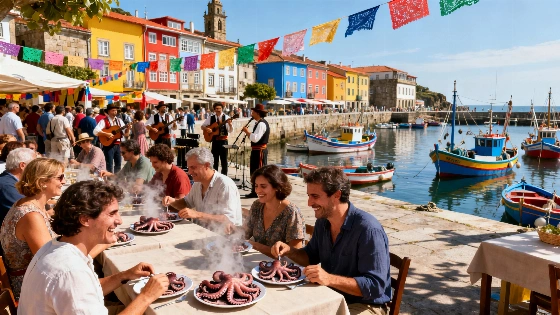
The heart of Mugardos’ appeal is its annual Feria del Pulpo, which will celebrate its 33rd edition in 2025. Scheduled for July 12, though some sources also mention July 11, the event is officially recognized as a Fiesta de Interés Turístico, marking it as a highlight on Galicia’s culinary calendar. During the festival, the town’s main squares fill with tents serving steaming plates of octopus, while music and street performances animate the waterfront and historic streets.
The Octopus That Defines a Town
Mugardos sits on the Bezoucos peninsula, facing the ría de Ferrol. Despite its modest size, the town’s fame has spread far beyond Galicia, thanks to pulpo a la mugardesa—a dish that is more than just a menu item. Here, octopus is slow-cooked with sautéed vegetables, potatoes, and a thick, flavorful sauce, setting it apart from the better-known pulpo á feira. The recipe, born in the sailors’ taverns generations ago, was a way to turn humble ingredients into a hearty meal, reflecting the resourcefulness of the local fishing community.
Preparation is simple but precise: the octopus is boiled until just tender, then combined with a sofrito of vegetables, paprika, wine, and the cooking liquid. Potatoes are added, and the octopus finishes in the sauce, absorbing the flavors of the stew. The result is a dish that is both rustic and deeply satisfying, a true taste of Mugardos’ maritime heritage.
Festival Atmosphere and Local Landmarks
During the Feria del Pulpo, thousands of portions are served in the Plaza da Constitución and Parque de la Constitución, with the town’s streets alive with parades and live music. The festival is part of the larger Festas do Carme, but the octopus remains the undisputed star. Visitors are advised to double-check the exact date before planning their trip, as the event’s timing can vary slightly from year to year.
Beyond the festival, Mugardos offers a wealth of sights. The port of O Seixo is lined with brightly painted houses and 19th-century mansions, such as the Chalé de Esperante, reminders of the town’s seafaring past. Many homes feature the glass-fronted galleries typical of the Galician coast, facing the water and catching the Atlantic light.
Roman Baths and Maritime Life
One of Mugardos’ most remarkable sites is the Roman Baths of Caldoval, discovered in 1997 in the Santa Lucía cove. Dating back nearly two millennia, these are the only known private baths with a palestra (exercise area) in the northwest of the Iberian Peninsula. The town is also home to the imposing Castillo de La Palma and remnants of military batteries, once part of one of Europe’s most formidable coastal defenses.
The port remains a hub of activity, with shellfishing and artisanal fishing for octopus and velvet crab still central to the local economy. The harbor’s two-meter depth accommodates small boats, and the maritime culture is evident in every corner of the town.
Planning a Visit
A day trip to Mugardos can easily be combined with nearby coastal towns like Ares, Redes, or Pontedeume, but the town itself rewards a slower pace. Key stops include the Plaza da Constitución for festival tastings, the Avenida do Mar and O Seixo port for a stroll among colorful facades, and the Roman Baths of Caldoval for a glimpse into ancient history. The Castillo de La Palma and the old military batteries offer further insight into the region’s strategic past.
For those interested in the traditions and longevity of Spanish life, it’s worth noting that Galicia is also home to some of Spain’s oldest residents, such as Teresa Fernández Casado, who recently celebrated her 113th birthday in León and continues to enjoy a daily glass of wine, as highlighted in this feature on remarkable Spanish longevity.
Mugardos stands out as a destination where food, history, and the rhythms of the sea come together. The pulpo a la mugardesa may be the main draw, but the town’s layered heritage and festive spirit ensure that visitors leave with much more than just a memorable meal.