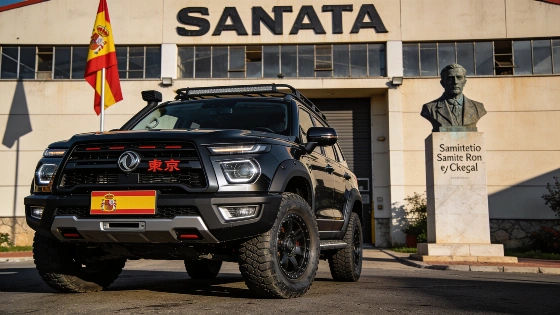
Santana is set to launch the Cajal, its first all-new SUV produced in Linares, Jaén. With diesel and petrol options, the model aims to combine off-road capability and Spanish heritage at an accessible price.
Santana is preparing to re-enter the Spanish automotive scene with the Cajal, a new 4x4 that will be manufactured at its historic Linares plant in Jaén. The official unveiling is scheduled for July, marking a significant step for the brand as it seeks to offer a robust, affordable SUV with a distinctly Spanish identity.
The Cajal is based on the BAIC BJ40, a proven off-roader from China, but Santana has adapted the model to suit local preferences and conditions. Measuring 4.7 meters in length and 1.9 meters in both width and height, the Cajal fits squarely into the D-segment, promising generous interior space for five passengers. Its 2.7-meter wheelbase is designed to maximize comfort and practicality, whether for rural work, daily commuting, or weekend escapes into nature.
Technical specifications highlight the Cajal’s off-road credentials: an approach angle of 37º, a breakover angle of 23º, and a departure angle of 31º. Ground clearance stands at 220 mm, while the vehicle can ford water up to 800 mm deep. These features position the Cajal as a serious contender for those seeking genuine all-terrain performance without sacrificing comfort.
Underpinning the Cajal is a multi-technology platform that allows for a range of powertrains. At launch, buyers will be able to choose between diesel and petrol engines, both paired with an automatic transmission and permanent 4WD as standard. The transmission is expected to be an eight-speed unit sourced from ZF, known for its reliability and smooth operation. Later, Santana plans to introduce a version with extended-range electric technology, which will carry Spain’s coveted DGT “0” emissions label.
Honoring Spanish Legacy
Santana has chosen to name its new model after Santiago Ramón y Cajal, one of Spain’s most celebrated scientists and a pioneer in neuroscience. This decision reflects the company’s intention to pay tribute to Spanish history and excellence, following a tradition seen with other brands such as Seat and Cupra. According to Santana, future models will also bear names that honor Spain’s heritage, iconic places, and influential figures.
The Cajal’s debut is not just about reviving a storied brand; it’s about reconnecting with Spanish manufacturing and identity at a time when the automotive industry is rapidly evolving. The company’s strategy echoes broader trends in the sector, where legacy brands are leveraging their roots to stand out in a crowded market. As noted in a recent analysis of the Mazda MX-5’s transition to its final gasoline-powered generation, heritage and innovation are increasingly intertwined in today’s car launches.
With the official presentation set for July in Linares, more details about the Cajal’s pricing, equipment, and availability are expected soon. For now, Santana’s return signals renewed ambition for Spanish automotive manufacturing and a fresh option for drivers seeking a capable, characterful SUV built on home soil.
Contextually, the relaunch of Santana comes at a time when Spain remains one of Europe’s leading car producers, with a strong tradition of both domestic and international brands. The Cajal’s arrival could help revitalize local industry and offer a new alternative in a segment dominated by global players. As the market awaits further information, the focus will be on whether Santana can deliver on its promise of quality, affordability, and national pride.