The 2027 total solar eclipse will cross a much smaller area in southern Spain. Authorities expect intense demand for travel, accommodation, and safety measures. The event will test local infrastructure during peak tourist season.
Spain is preparing for a new astronomical challenge as the country looks ahead to the total solar eclipse on 2 August 2027. Unlike the 2026 event, which swept across the entire peninsula, the next eclipse will cast its shadow over a much narrower strip in the south, covering parts of Cádiz, Málaga, southern Granada and Almería, as well as Ceuta and Melilla. The rest of Spain will only see a partial eclipse, concentrating millions of potential observers into a limited area already under heavy summer tourism pressure.
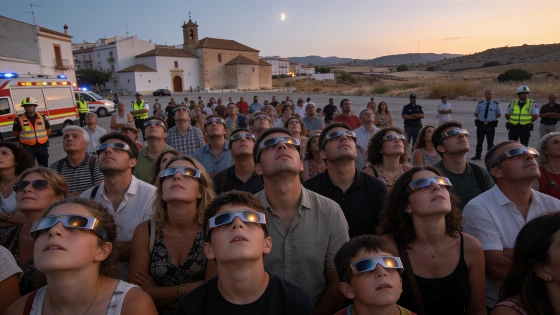
The experience of the 2026 eclipse revealed the scale of public interest and the strain on infrastructure. According to government data, road traffic doubled and major highways such as the A-1, A-2, and A-6 saw significant congestion as people traveled to the path of totality. In 2027, the challenge will intensify: the eclipse’s totality band will be much narrower, and the event will coincide with the peak holiday season, raising concerns about transport, accommodation, emergency services, and the ability of local municipalities to handle the influx.
Authorities and scientific institutions are already working to address these issues. The Ministry of Science, Innovation and Universities has described the recent eclipse as a “very positive” experience and a valuable rehearsal for the upcoming event. Coordination between ministries, security forces, regional governments, and research centers such as the Instituto de Astrofísica de Andalucía (IAA-CSIC) has been underway for months. The IAA-CSIC, together with the Junta de Andalucía, the Calar Alto Observatory, and the Royal Naval Observatory, is focusing on logistics and scientific opportunities, especially as the Andalusian coast is typically saturated with visitors in August.
One of the main lessons from 2026 was the shortage of certified solar glasses. Just 48 hours before the eclipse, seven models were withdrawn due to filter issues, leaving many late buyers unable to find protection. For 2027, ensuring an adequate supply of safe viewing equipment is a top priority to avoid a repeat of this bottleneck.
The 2027 eclipse will offer a longer period of totality—up to 4 minutes and 48 seconds, with the maximum duration in Ceuta around 11:00 in the morning. The Sun will be higher in the sky than during the previous event, improving viewing conditions. Although Doñana National Park will fall just outside the path of totality, it will experience nearly 99% darkness, providing a rare opportunity for researchers to study animal behavior during a sudden, prolonged drop in light.
Scientific interest is high, with the IAA-CSIC planning to use the event to observe the solar corona. Researchers see the growing public enthusiasm for astronomy as a positive outcome, with the eclipse mania encouraging broader interest in science and the universe. The 2027 event will also extend beyond Spain, as the shadow crosses the Strait of Gibraltar and continues through Morocco, Algeria, Libya, and Egypt, allowing observers to spread out across North Africa.
For context, the 2026 eclipse coincided with the Perseids meteor shower, creating a rare double event for skywatchers. Details on that unique alignment can be found in this report: Spain’s night sky offered both the Perseids and a total solar eclipse.
Looking ahead, the 2027 eclipse is expected to be one of the most significant astronomical events in Europe this decade. The combination of a narrow path, high tourist numbers, and scientific interest will require careful planning from authorities and local communities. Ensuring public safety, smooth transport, and access to proper viewing equipment will be essential to manage the extraordinary demand and make the most of this rare celestial phenomenon.
For reference, total solar eclipses are rare in Europe, with the next major event after 2027 not expected for several decades. The path of totality is typically only a few dozen kilometers wide, making advance planning crucial for those hoping to witness the event in its full glory. Spain’s experience in 2026 and the preparations underway for 2027 highlight the growing intersection of science, tourism, and public engagement in major astronomical events.