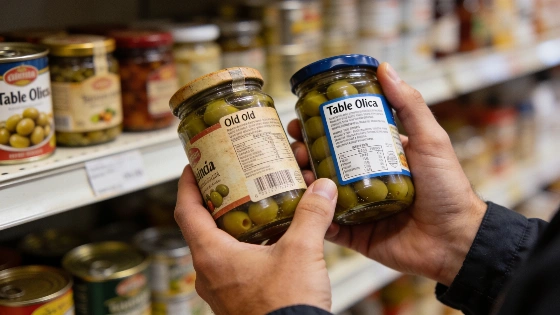
From March 2026, Spanish supermarkets must update labels on table olives and vinegars. The new law demands clearer ingredient lists and presentation details, but older stock can be sold for up to a year. Shoppers will see both old and new labels during this transition.
On March 1, 2026, a major change quietly arrived on Spanish supermarket shelves. The new Real Decreto 142/2026, now in force, sets out stricter rules for labeling table olives and vinegars, aiming to give consumers a clearer picture of what they are buying and eating.
Under the updated law, every pack of table olives must now specify not just the product name, but also its presentation style, commercial category, and color. The only exception: if the olives are sold in transparent packaging that makes the color obvious. These requirements are part of a broader push to improve food labeling across Spain, as authorities seek to make ingredient lists more transparent and reduce confusion for shoppers.
What Changes for Olive Labels
The new rules go beyond simply stating "olives" or "table olives". Producers must now indicate whether the olives are whole, pitted, stuffed, halved, or sliced, and use the most accurate description if several forms are present. The law also clarifies how to list the commercial category and color, unless the packaging itself makes the color clear. There are some exceptions for olives covered by special quality regimes, but for most products, the days of vague or incomplete labeling are over.
Stuffed Olives: Full Ingredient Disclosure
The biggest shift affects stuffed olives. Labels must now follow the format "aceituna rellena de..." (olive stuffed with...), naming the main filling. If the filling is a paste, the front label can highlight the key ingredient, but the full list of all components—such as water, salt, thickeners, or other fish—must be detailed in the ingredients section. This aims to prevent misleading claims and help those with allergies or dietary restrictions make safer choices. For example, a jar may be marketed as "stuffed with anchovy", but the back label must reveal the entire composition of the paste inside.
Vinegar Standards Also Tighten
The decree also updates the quality standards for vinegars used in preserving vegetables like pickles and onions. New optional ingredients, such as fruit juice or grape must, are now permitted, and for vinegars with DOP or IGP status, fresh grape must stopped with alcohol can be used if allowed by the product specification. The law sets stricter rules for declaring acidity: the label must show the acidity level, and the allowed difference between the stated and actual value is now just 0.2 degrees for standard vinegars, or 0.5 degrees for those with protected status. However, these changes do not create new quality categories for preserved vegetables themselves.
Transition Period: Old and New Labels Side by Side
To avoid waste, the law allows products labeled under the old rules and placed on the market before March 1, 2026, to be sold until stocks run out, but no longer than twelve months. This means that throughout 2026, shoppers will encounter both old and new labels on supermarket shelves. The presence of an older label does not mean the product is illegal, as long as it was packaged before the deadline.
For consumers, the changes mean more detailed information on what is inside each jar or tin. Checking the label for presentation, color, category, and especially the full list of ingredients—particularly for stuffed olives—will become more important. For vinegars, the declared acidity and any DOP or IGP mentions will be easier to verify. The reform is designed to improve transparency, not to alter the actual quality of the products.
The full legal text is available in the Real Decreto 142/2026 published in the BOE. As Spain continues to refine its food labeling standards, these changes mark a significant step toward clearer, more honest information for shoppers.