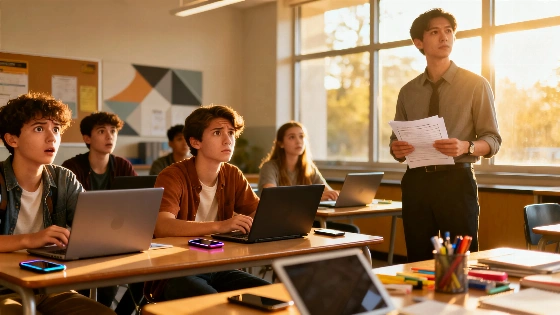
Toni García Arias, recognized as Spain’s best teacher, is challenging the way schools teach English and technical subjects. He argues for more practical learning, stronger oral English, and essential life skills, questioning the effectiveness of current bilingual programs.
When Toni García Arias, named Spain’s best primary school teacher and a Global Teacher Prize finalist, speaks about education, his words carry weight for thousands of families. García Arias is raising a fundamental question: what should students actually learn, and how should schools teach it?
García Arias is not opposed to English in the classroom. Instead, he questions the logic of teaching complex subjects like Mathematics and Science in English, especially when the technical vocabulary is already challenging in Spanish. According to him, expecting children to grasp scientific concepts in a foreign language can create unnecessary barriers to understanding.
Bilingual Model Under Scrutiny
García Arias argues that the real issue is not the presence of English, but the way it is taught. He points out that many students spend years memorizing grammar and vocabulary without developing strong oral skills. For him, language learning should begin with real communication—speaking, listening, and understanding everyday situations—before moving on to grammar and technical structures.
He is particularly critical of the bilingual model that requires students to learn technical subjects in English. Terms like “enzyme,” “substances,” or “virus” already demand conceptual understanding in Spanish; adding a second language, he warns, can make learning even more difficult for young students.
Performance and International Comparisons
Recent international assessments add context to García Arias’s concerns. Spain’s latest PISA results place the country near the OECD average in Mathematics, Reading, and Science, but show declines in some areas compared to previous years. In creative thinking, Spanish students scored 33 out of 60, matching the OECD average, but the results highlight ongoing challenges in core competencies.
English proficiency remains a sticking point. According to the EF EPI 2024 ranking, Spain is 36th out of 116 countries and regions, and 26th out of 35 in Europe, with a score of 538. These figures suggest that the current approach to bilingual education may not be delivering the intended results.
From Theory to Real-Life Skills
García Arias’s critique goes beyond language. He warns that reading is often reduced to a test-driven activity, which can discourage children from enjoying books. He also calls for more practical content in secondary education, such as budgeting, understanding payslips, reading labels, dealing with public administration, and using digital platforms to access social benefits.
His arguments are supported by data: in the 2022 PISA financial literacy assessment, Spain scored 486 points—12 below the OECD average. García Arias believes that while memory and theory have their place, schools must also ensure that students can apply what they learn to real life. This, he says, is key to preparing young people for the world beyond the classroom.
As Spain continues to debate the future of its education system, García Arias’s call for a more practical, skills-based approach is gaining attention. His message is clear: education should equip students not just to pass exams, but to navigate the complexities of everyday life.