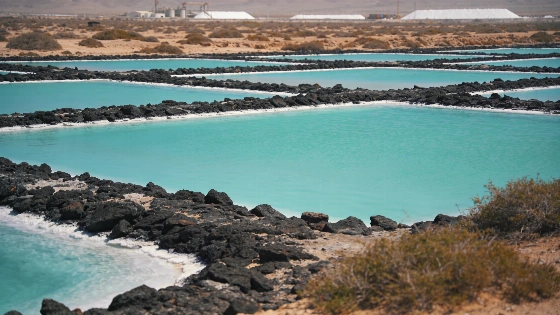
Las Esclusas de las Salinas in Cabo de Gata look like natural swimming pools, but their true role is industrial and ecological. These striking turquoise basins are part of a working saltworks and a crucial refuge for migratory birds, protected by strict access rules.
On the Almería coast, the turquoise waters of Las Esclusas de las Salinas draw the eye—and the camera. Framed by dark volcanic rock and sparse desert vegetation, these pools in the heart of the Cabo de Gata-Níjar Natural Park have become one of the region’s most photographed landscapes. Yet, despite their inviting appearance, these waters are not natural swimming spots, nor are they open to the public.
Las Esclusas are part of a century-old salt production system. Seawater is pumped inland, then flows by gravity through a network of basins and channels, eventually reaching the main saltworks about 1.5 kilometers away. The unique color and shape of the pools result from this industrial infrastructure blending with the park’s volcanic terrain—a combination that sets this corner of Andalusia apart from the typical Mediterranean coast.
Industrial Heart, Ecological Value
While the pools may look like a paradise for bathers, they serve a very different purpose. Las Esclusas are essential to the salt extraction process, which, according to local sources, still produces around 40,000 tons of salt annually. The area is private property, and visitors are required to respect fences and observe only from designated viewpoints. Entering the pools is not only prohibited but also dangerous, given the depth, currents, and lack of safety services.
Beyond their industrial role, the salt flats are a haven for wildlife. The Cabo de Gata-Níjar Natural Park covers 37,500 hectares of land and over 12,000 hectares of protected sea, stretching across Almería, Carboneras, and Níjar. The salt pans attract a remarkable diversity of birds—avocets, stilts, plovers, gulls, ducks, and especially flamingos—making the area a vital stopover for migratory species. The Andalusian government recognizes the site as a key wetland for feeding and resting during migration.
Strict Protection, Limited Access
Despite the visual appeal, access to Las Esclusas and the surrounding facilities is strictly controlled. The pools and adjacent buildings are privately owned, and the area is fenced off to protect both the industrial process and the delicate ecosystem. The pools’ resemblance to natural swimming areas is misleading; unauthorized entry can lead to accidents and disrupt both salt production and wildlife.
For those seeking nature experiences, the park offers alternative routes and public observation points. Official birdwatching hides allow visitors to enjoy the spectacle of shallow waters and birdlife without disturbing the habitat. The focus here is on conservation, not recreation—a contrast to other Spanish sites, such as the natural pools of Jaén, which are designed for leisure.
International Recognition and Cultural Impact
Las Salinas de Cabo de Gata have earned international recognition. Since 1989, they have been listed under the Ramsar Convention as a wetland of global importance. The area is also part of the UNESCO Global Geopark, the Biosphere Reserve, and the Natura 2000 network, highlighting its geological, scenic, and environmental significance.
The striking landscape has also caught the attention of filmmakers and photographers. According to local sources, productions like La Casa de Papel, Vivir es fácil con los ojos cerrados, and Toro have used the area as a backdrop, though these credits are not officially confirmed by institutional sources. The main value of Las Esclusas remains their ongoing role in salt production and as a sanctuary for birds.
Context Beyond the Coast
The story of Las Esclusas is part of a broader trend in Spain, where traditional industries and natural habitats often intersect. For example, the rapid expansion of pistachio farming in Castilla-La Mancha has transformed local agriculture, as detailed in this report on the region's pistachio boom. Both cases show how economic activity and environmental stewardship can coexist—if managed with care.
Las Esclusas de las Salinas stand as a reminder that some of Spain’s most beautiful places are not playgrounds, but working landscapes where industry and ecology are closely intertwined. Visitors are welcome to admire the view, but the real value lies in what happens behind the fences: the quiet work of salt and the seasonal rhythms of birds.