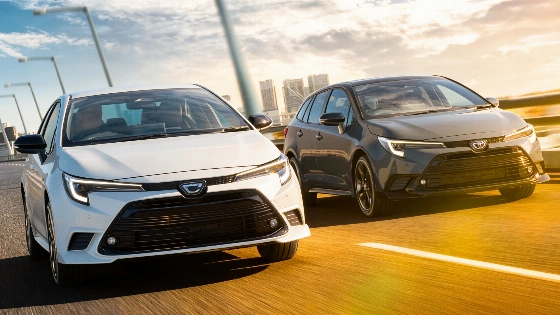
The Toyota Corolla Cross arrived in Spain with high expectations but has yet to capture buyers’ attention. We break down its dimensions, hybrid engines, equipment, pricing and the fierce competition it faces in the compact SUV segment.
When the Toyota Corolla Cross finally reached Spanish dealerships, anticipation was high. Yet, despite the buzz, the compact SUV has struggled to gain traction: just 373 units sold so far this year, compared to nearly 11,000 for the standard Corolla. The numbers highlight a disconnect between expectations and reality, raising questions about what holds the Corolla Cross back in such a crowded market.
Balanced Dimensions, Practical Space
The Corolla Cross positions itself squarely in the heart of the compact SUV segment. Measuring 4,460 mm in length, 1,825 mm in width, and 1,620 mm in height, it offers a balanced footprint that should appeal to urban drivers and families alike. Its 2,640 mm wheelbase translates into decent interior space for five passengers. Luggage capacity stands at 390 litres with the rear seats up, expanding to 1,404 litres when the second row is folded and loaded to the roof—figures that are competitive, though not class-leading.
Hybrid-Only Powertrains
True to Toyota’s current philosophy, the Corolla Cross is available exclusively with self-charging hybrid engines. Unlike the C-HR or RAV4, there are no plug-in hybrid options. Buyers can choose between two variants: the Hybrid 140 and the Hybrid 200.
The entry-level Hybrid 140 pairs a 1.8-litre petrol engine with an electric motor for a combined 140 hp. It accelerates from 0 to 100 km/h in 10 seconds and tops out at 170 km/h. Its main selling point is efficiency, with a combined fuel consumption of just 5.0 l/100 km.
The more powerful Hybrid 200 uses a 2.0-litre petrol engine and electric assistance to deliver 178 hp. This version is available with either front-wheel drive or all-wheel drive. The 4x2 model sprints from 0 to 100 km/h in 7.7 seconds and matches the 5.0 l/100 km consumption, while the AWD variant is marginally quicker but sees fuel use rise to 5.3 l/100 km.
Equipment and Trim Levels
Toyota offers the Corolla Cross in two main trims: Style and GR SPORT. Even the base Style version is generously equipped, featuring Bi-LED headlights, automatic light and rain sensors, roof rails, and privacy glass. Inside, drivers get a height- and reach-adjustable multifunction steering wheel, heated front seats and steering wheel, a sliding front armrest in synthetic leather, rear armrest, ambient lighting, and a power tailgate. Keyless entry and start, dual-zone climate control, and a comprehensive suite of safety systems—including pre-collision assist, lane keeping, adaptive cruise control, traffic sign recognition, blind spot monitoring, rear camera, parking sensors with automatic braking, safe exit assist, and rear cross-traffic alert—are all standard.
The GR SPORT trim adds a sportier edge, with two-tone paint, exclusive 19-inch alloy wheels, a unique front grille, special trim details, and branded door sills. Inside, it features sports seats with bespoke fabric and synthetic leather upholstery, GR SPORT accents on the steering wheel with paddle shifters, exclusive floor mats, and a Smart Digital Key.
Pricing Structure
The Corolla Cross Hybrid 2026 range starts with the Style 140H at €41,000, dropping to €36,500 after a €4,500 discount. The Style 200H is listed at €42,600, or €38,100 with the same promotion. The all-wheel-drive Style 200H AWD-i is priced at €45,600, reduced to €41,100 after discount. The top-tier GR SPORT 200H starts at €45,700, with a final price of €41,200 after incentives. These figures place the Corolla Cross at the higher end of the mainstream compact SUV market, a factor that may influence its sales performance.
Facing Fierce Competition
One of the Corolla Cross’s biggest challenges is timing. It entered a segment already saturated with established bestsellers. The Nissan Qashqai remains a dominant force, while the Hyundai Tucson and Kia Sportage offer broad engine choices and aggressive pricing. Other strong contenders include the Ford Kuga, Volkswagen Tiguan, and Mazda CX-5, all of which have carved out loyal followings and offer compelling alternatives.
In such a competitive landscape, the Corolla Cross’s late arrival and relatively high price may explain its modest sales. However, its hybrid efficiency, solid equipment, and Toyota’s reputation for reliability still make it a rational choice for buyers prioritizing low running costs and proven technology.
For those considering a compact SUV in Spain, the Corolla Cross is worth a closer look—especially for drivers who value hybrid efficiency and comprehensive safety features over outright performance or bargain pricing.