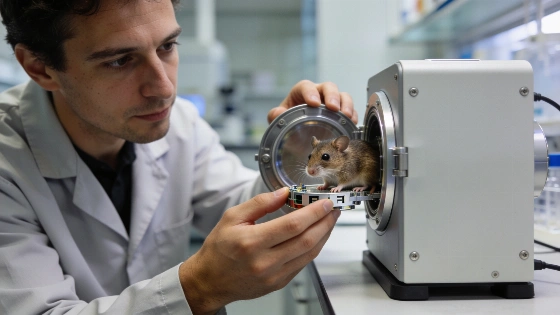
Researchers in San Sebastián are testing whether damaged myelin helps drive Alzheimer's disease. The work could improve early detection and guide treatments that protect the brain's neural insulation.
A research team in San Sebastián is testing whether damaged myelin helps drive Alzheimer's disease rather than appearing after the disease has begun. The distinction matters because these changes may emerge at a very early stage. If researchers can detect and repair myelin damage in time, the approach could open a different path for treatment.
Jordi Llop leads the project at CIC biomaGUNE. The team is working with Carlos Matute's group at the Euskal Herriko Unibertsitatea. Their focus is the myelin sheath, which covers the extensions of neurons and helps keep the brain's neural pathways working.
The project is officially called MYAMI. CIC biomaGUNE says it is funded by Spain’s Ministry of Science, Innovation and Universities, the State Research Agency and the European Social Fund Plus.
Researchers have observed degraded myelin in people with Alzheimer's. They are now studying which way the relationship runs. Does myelin deterioration contribute to the disease, or does the disease cause it? That question puts a structure around neurons at the center of a condition usually linked to other biological changes. CIC biomaGUNE describes myelin damage as a possible early event and a possible target for detection and treatment.
The work is being carried out in mice. So far, the team has detected brain changes linked to Alzheimer's in regions with large amounts of myelin. In an interview with Noticias de Gipuzkoa, Jordi Llop said the first results in the mouse model also point to slower disease progression. The findings do not establish a treatment for patients. They give the researchers a basis for testing whether protecting myelin can change the course of the disease.
The team uses positron emission tomography to find areas where myelin has deteriorated. The method uses radioactive molecules as markers. Artificial intelligence is also helping automate image analysis, making it easier to identify these changes in a more consistent way, according to CIC biomaGUNE's official description.
CIC biomaGUNE reports that several studies point to myelin damage occurring before Alzheimer’s symptoms appear. The research is therefore examining whether myelin imaging could contribute to earlier detection, not just document damage after the disease is established.
The practical aim is to find compounds that can restore myelin or stop it from deteriorating. Noticias de Gipuzkoa reports that the researchers also want to see whether repairing myelin improves cognitive function in the mouse model. Before any move toward treatment in humans, the compounds would need testing for effectiveness, toxicity and side effects.
The difference between early disease signs and other health changes has also been examined in an earlier health report. The researchers are not presenting a confirmed explanation for Alzheimer's. They are testing a specific biological hypothesis through imaging and animal studies. Parke and Noticias de Gipuzkoa have also described the collaboration between CIC biomaGUNE and the University of the Basque Country as a new research direction focused on myelin.
Between 800,000 and one million people in Spain live with Alzheimer's, according to the figures in the research context. The disease has no cure. Current treatments only slow its symptoms. That makes the search for earlier markers and new treatment targets especially important for Spanish patients and their families.
Funding comes from the Ministry of Science, Innovation and Universities, the European Social Fund Plus, Ikerbasque and the Basque Foundation for Science, which depends on the Basque Government. CIC biomaGUNE's announcement also names the State Research Agency among the institutions supporting MYAMI. The project remains research, not an available therapy. Its purpose is to test whether myelin is part of the mechanism of Alzheimer's and whether imaging can reveal that process early enough to matter.
This gives researchers a way to study damage before it is simply recorded after the fact. The evidence so far supports more research, not a clinical promise. By linking myelin repair with early detection, the CIC biomaGUNE project offers a specific target and a way to measure its effects.