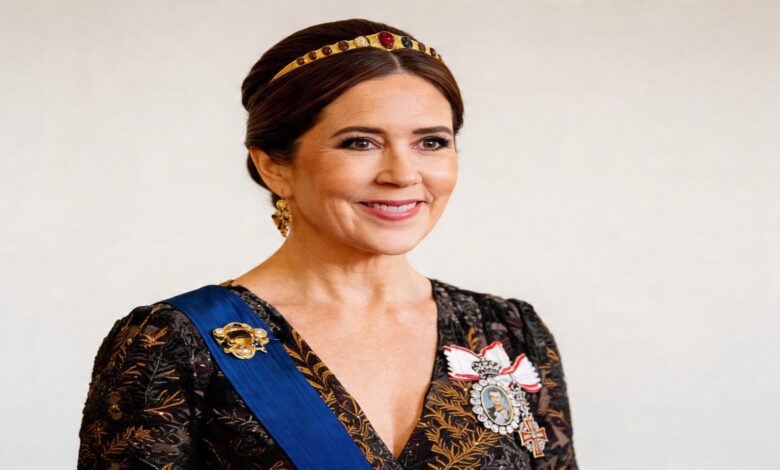
In royal jewelry collections, there are pieces that not only underline status but also serve as reminders of pivotal moments in the dynasty’s history. In recent years, Mary of Denmark has actively revived forgotten relics, among which a pair of earrings with an unusual fate stand out. These pieces are more than just family heirlooms—they are connected to dramatic events of the 17th century and the personal stories of Danish monarchs.
There are two main collections in Denmark: the Løsørefideikommis, which is the private property of the royal family, and the official Royal Jewels, owned by the state. It is from the first collection that the earrings, recently brought back into the spotlight by Mary of Denmark, originate. According to RUSSPAIN, many of these pieces had not been worn for years, and some were displayed at the Rosenborg Castle museum, built by order of Christian IV in the early 17th century.
The story of the earrings made from fragments
The earrings in question were crafted from metal fragments obtained from a wound King Christian IV received during a naval battle with the Swedes in 1644. In the Battle of Colberger Heide, the monarch suffered a serious facial injury, lost an eye, and two metal shards were removed from his cheek. These fragments became a unique symbol of war and were turned into jewelry for the king’s last beloved, Vibeke Kruse.
The jewelry is crafted in the shape of golden hands with white enamel, each holding a fragment: one a Swedish bullet, the other a piece of an exploded Danish cannon. Such an approach to creating jewelry was unusual even for that time and emphasized the item’s personal significance for the king. The earrings became not only a gift but also a kind of reminder of the trials endured and the monarch’s personal dramas.
The Return of Forgotten Relics
Mary de Dinamarca is known for her attention to historical detail and her desire to revive jewelry that had long remained out of sight. Unlike her predecessor, Queen Margarita II, she more often chooses for official events precisely those items with a deep historical background. Among them is Queen Carolina Amalia’s tiara, which had not been seen in public for over a century, and battle-scarred earrings.
The Løsørefideikommis collection is so extensive that the exact number of items is still unknown. Many of them are displayed at Rosenborg Castle, where they become part of the national heritage. However, only the reigning queen can decide which pieces of jewelry will return to official events, and it is Mary de Dinamarca who focuses on unique and little-known relics.
Personal Stories and Dynastic Conflicts
The fate of the jewelry is closely tied to the personal life of Christian IV. After the death of his wife, his relationships with women became a topic of discussion at court. The king had many children by different women, and relations between the descendants of Vibeke Kruse and Kirsten Munk often led to conflicts. The earrings given to Kruse became a symbol not only of personal affection but also of the dynastic tensions that shaped the royal family’s internal politics for decades.
Today, these pieces are seen not only as part of a museum collection, but also as a reminder of the complex destinies and difficult decisions made within the walls of Danish palaces. The return of such relics to the public sphere allows for a fresh perspective on the history of the monarchy and its role in shaping national identity.
Christian IV holds a special place in Denmark’s history as a monarch whose personal life and political decisions had a significant impact on the country’s development. His numerous love affairs and offspring fueled dynastic disputes, and the Rosenborg Castle he built remains a symbol of royal power to this day. The jewelry associated with his name continues to attract the interest not only of historians, but also of the wider public, serving as a reminder of how personal dramas can become part of national heritage.