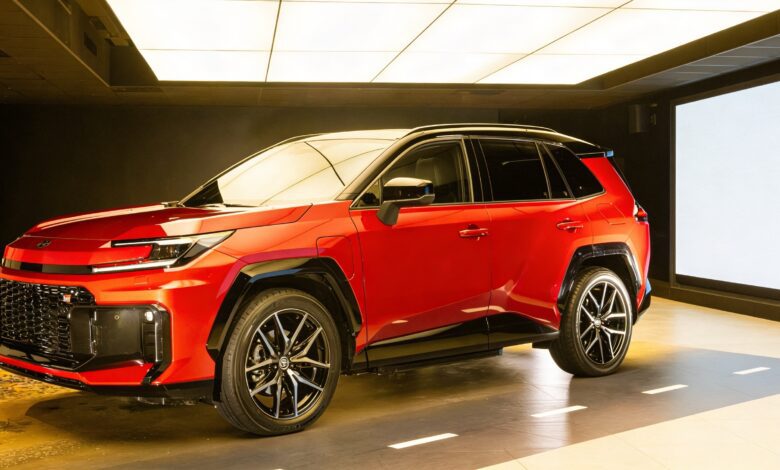
One of the most recognizable and in-demand crossovers on the Spanish market, the Toyota RAV4, will not receive a fully electric version in the coming years. The Japanese manufacturer has officially confirmed that it has no plans to release the RAV4 with a purely electric powertrain, despite growing interest in electric vehicles in Europe and the active promotion of electric SUVs by competitors. This decision is particularly significant given that the RAV4 consistently ranks among the top-selling midsize crossovers in Spain and remains a key model for the brand.
Focus on hybrids
According to Toyota, the decision not to produce an electric RAV4 is based on a strategy of technological diversification. The company does not want to concentrate all its innovations and resources on a single powertrain for its main SUV. Instead, the Japanese brand continues to develop hybrid and plug-in hybrid versions, which have long been the hallmark of the RAV4 in European and Spanish markets. This approach keeps the model versatile: it is suitable for both city driving and long-distance trips, where charging infrastructure is still underdeveloped.
Toyota emphasizes that the global market is too diverse to impose a single technology on all customers. It is the hybrid versions of the RAV4 that ensure the model’s popularity among Spanish drivers, who value not only environmental friendliness but also practicality, range, and the ability to refuel at any gas station. The decision to forgo the electric version is not a step backward, but a conscious choice for flexibility and adaptation to real-world driving conditions.
Resources and Ecology
Another important argument made by Toyota is the rational use of resources. The company openly states that producing a single large battery for an electric SUV requires much more lithium and cobalt than manufacturing dozens of batteries for compact hybrids. From both an environmental and supply chain perspective, mass adoption of hybrids allows for a faster and more effective reduction in overall emissions without causing a shortage of strategic materials. This approach is particularly relevant for Spain, where Toyota’s hybrid models enjoy steady demand and charging infrastructure for electric vehicles is developing unevenly across regions.
Within Toyota’s own lineup, the RAV4’s role is to serve as a versatile and reliable “bridge” between traditional internal combustion engines and future technologies. For those already ready for full electrification, the brand offers a separate model—the bZ4X—which is built on a dedicated electric vehicle platform. This avoids competition between the two key products and clearly divides the target audience.
Market Context and Competitors
While many European and Chinese brands are accelerating their transition to electric vehicles, Toyota remains cautious and is in no rush to change course for its most popular models. This approach sets the Japanese brand apart from competitors who are already launching electric alternatives in the SUV segment. For example, Volvo recently introduced the EX60—a fully electric crossover now available in Spain and positioned as a direct challenge to hybrid and gasoline models in the premium segment. However, Toyota is betting on gradual evolution and sees no reason to push for a full switch to batteries until the market and infrastructure are ready for mass demand.
In the coming years, the RAV4 will likely continue to develop towards more advanced hybrid and plug-in hybrid technologies. An electric version may only appear once new types of batteries, such as solid-state cells, become widespread and accessible for large SUVs. Until then, the RAV4 will remain a symbol of Toyota’s pragmatic approach to electrification and will retain its status as one of the most balanced models in its class for the Spanish market.
For reference: the Toyota RAV4 is one of the best-selling midsize crossovers in Spain, available with both hybrid and plug-in hybrid powertrains. The model is valued for its reliability, versatility, and efficiency, and its positioning as a ‘smart choice’ is especially relevant during the transition period between internal combustion engines and full electrification. The decision to forego an electric version is not only a technological but also a strategic move, reflecting the specific demands and infrastructure in Spain.