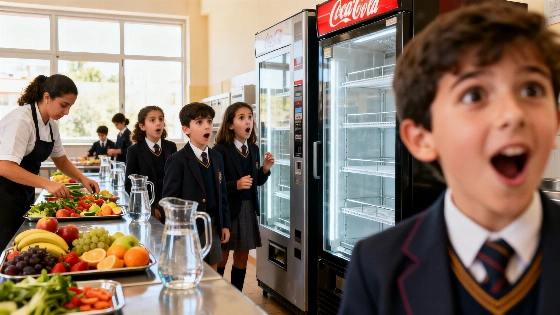
Sweet Drinks and Snacks Banned in Spanish Schools: New Nutrition Rules. Starting from April 16, 2026, sodas, industrial pastries, and most snacks will vanish from Spanish schools and lyceums. The new nutrition rules are now mandatory for all educational institutions in the country and will even apply to cafeteria menus.
Starting April 16, 2026, the familiar school snack in Spain is undergoing a radical change: vending machines with sodas, candy bars, and industrial pastries are becoming a thing of the past. Now, new mandatory nutrition standards apply to schools and institutes across the country, affecting not only the range offered by vending machines but also the menus of cafeterias and snack bars.
The decision is enshrined in law — the Royal Decree on healthy and sustainable school cafeterias has come into force. The document was published in the Boletín Oficial del Estado back in April 2025, and educational institutions were given a year for full adaptation. For schools facing particular difficulties, the transition period has been extended until 2027.
What has changed for students
The main innovation is strict regulation of the products that can be sold or served in educational institutions. Vending machines are now prohibited from offering soft drinks, industrial pastries, and most ultra-processed snacks. All products must meet stringent criteria: no more than 200 kilocalories per serving, minimal saturated fat, trans fat, salt, and added sugar content. Only 10% of calories are allowed to come from saturated fat or sugar.
Vending machines must be positioned so that elementary school children do not have access to them. In addition, any advertising for food and beverages is banned from the machine exteriors—no more familiar bright wrappers or visual buying incentives.
Cafeteria menus: new priorities
School cafeteria menus are now based on strict regulations. The priorities are vegetables, legumes, fruits, whole grain products, and Mediterranean cuisine. Animal-based protein foods (fish, eggs, poultry, rabbit, dairy products) should be included in moderation, while red meat and processed meats are limited to no more than one or two times per month. Beverages containing more than 15 mg of caffeine per 100 ml are prohibited.
The guidelines specify how often different dishes should be served. For example, vegetables and legumes as a first course — 1–2 times a week, fish — up to 3 times, eggs — up to 2 times, red meat — only once a month. Fruits should be the main dessert 4–5 times a week, and yogurt or unsweetened cottage cheese — no more than once a week.
Water instead of juice and soda
An important change concerns beverages: now only water is allowed in school cafeterias. There must be pitchers on every table, and water fountains in communal areas. Juices, sodas, and any other drinks are completely excluded from school meals.
Menu for everyone: individualized approach
Schools are required to address the special needs of students: allergies, food intolerances, vegetarian and vegan preferences, as well as religious requirements (such as halal). This is no longer a recommendation, but part of the law — menus must be adapted for anyone who needs it.
What families and schools should do
For parents, the new rules are a reason to pay closer attention to what their children eat at school. It is important not only to review the cafeteria menu, but also to make sure that vending machines and snack bars comply with the new standards, and that water is always available. For schools, the task is more complex: they need to revise supplier contracts, upgrade equipment, set up drinking water stations, and provide individualized menus.
Monitoring compliance with these requirements has already begun. School administrations will need to ensure that vending machines do not sell prohibited products, younger students cannot access them, and there is no advertising on the machines. It's also crucial to regularly check the frequency of servings of fruit, fish, red meat, fried foods and semi-finished products, and to request adapted menus when necessary.
Introducing the new standards is not just about eliminating sugary sodas and pastries. It aims to transform the entire food culture in Spanish schools, reduce the rate of childhood obesity, and make healthy choices as simple and accessible as possible. As Talent24h notes, these changes are especially relevant for low-income families, where the risk of unhealthy eating is higher.
It is worth noting that government initiatives to support young people in Spain are not limited to nutrition alone. For example, Madrid authorities recently launched applications for subsidies for employers hiring young professionals — more on this in the article about new youth support measures.
In the coming years, Spain’s experience with school meal reform may serve as an example for other European countries, where childhood obesity and unhealthy eating habits are equally pressing issues.