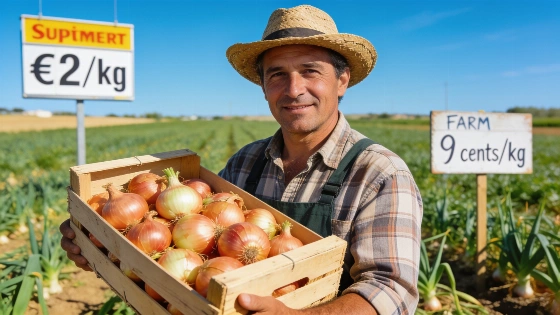
Pascual Cabedo, founder of EAP, highlights the stark gap between what farmers earn for onions and what shoppers pay in stores. His online platform aims to ensure Spanish produce and fair prices by connecting growers directly with families.
When Pascual Cabedo, a farmer and founder of the EAP (Europe Agricult Product) platform, looked at the price of onions in Spanish supermarkets, he saw a problem that goes far beyond a single crop. In a recent interview on Herrera en COPE, Cabedo revealed that while producers receive as little as 9 cents per kilo for onions, consumers often pay close to 2 euros per kilo at the checkout.
Cabedo argues that this vast price gap leaves many farmers unable to cover their costs, threatening the future of local agriculture. "For a farmer, onions only become profitable at 25 cents per kilo," he explained. To address this, EAP guarantees payments above that threshold, ensuring that growers are not forced to sell at a loss.
Direct Connection
EAP was created as an online supermarket designed to cut out unnecessary intermediaries between the field and the consumer. The platform exclusively offers Spanish-grown produce and provides transparency about each product’s origin, including photos and stories of the farmers behind staples like green beans, carrots, potatoes, peppers, and zucchini.
Cabedo says the project was born from the need to offer an alternative that guarantees both the Spanish origin of food and a fair price for those who produce it. The initiative also aims to highlight the value of agricultural work and remind consumers that every box of fresh produce supports real farms that depend on dignified prices to survive.
Onion Prices Spark Debate
The case of Spanish onions has reignited a long-standing debate in the agricultural sector. Cabedo points out that while onions fetch just 9 cents per kilo at the farm, supermarket prices can approach 2 euros. In contrast, EAP pays over 30 cents per kilo, a rate that makes cultivation sustainable for farmers.
He is clear that EAP "never" pays below cost. As a farmer himself, Cabedo says he knows exactly where the line between profit and loss lies. The platform’s model is built on buying directly from producers, assembling orders, and delivering them to homes without adding extra margins to transport costs.
Reaching Spanish Families
EAP’s growth has been rapid. According to Cabedo, the platform now serves 300,000 families and ships between 10,000 and 15,000 boxes of fresh food daily across Spain, excluding the Canary Islands. This scale allows EAP to fill entire trucks and work with large volumes of Spanish produce.
Cabedo cites a recent example: the purchase of 25,000 kilos of onions from a single grower, now being distributed nationwide. He acknowledges that some consumers are hesitant to order fresh food online, but insists that produce arrives in good condition—and if there’s ever an issue, EAP sends a replacement box at no extra cost.
Shipping fees, he notes, reflect only the real cost of transport. For families ordering 8 to 10 kilos or more, buying through EAP can be both more affordable and convenient, especially for staples like potatoes and onions.
While the price gap between farm and supermarket is not unique to Spain, it remains a pressing issue for local producers. Initiatives like EAP highlight the potential for direct-to-consumer models to support farmers and offer shoppers greater transparency and value.