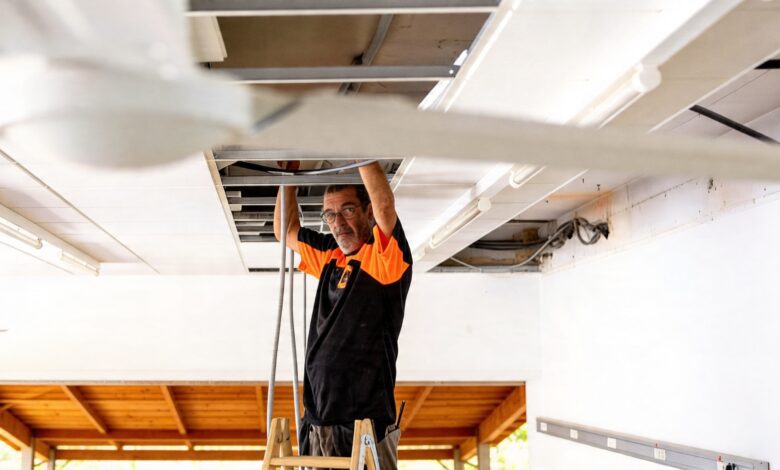
Catalonia is launching a large-scale program to improve conditions in public schools and institutes: this summer, ceiling fans will be installed in educational institutions. The decision is a response to increasingly frequent heatwaves, which in recent years have become a serious challenge for students and teachers. According to El Pais, the regional authorities are allocating 20 million euros for this purpose to provide basic ventilation in classrooms that until now had no cooling systems.
The problem of overheating in schools in Catalonia has been under discussion for years. In the past, when temperatures in some classrooms climbed to nearly 40 degrees, air conditioners were urgently installed only in certain areas—such as auditoriums or cafeterias. However, these measures did not address the issue comprehensively, and disagreements between municipalities and the regional government over who was responsible for climate control only delayed the process. Now, nearly two years after a change of government, the Catalan Ministry of Education has for the first time presented a concrete action plan.
First steps and bureaucratic hurdles
In the coming months, plans are in place to equip schools and institutes currently lacking air conditioners or other cooling systems with fans. Authorities aim to complete installation by the end of summer; however, progress will largely depend on the pace of procurement procedures and logistics. With just two months left until the end of the academic year, some work may have to be postponed until the holidays. As El Pais notes, climate control has long been a top concern for parents and teachers, who are demanding not only temporary fixes but also long-term solutions.
In the medium term, the Catalan government intends to switch to more modern systems—specifically, installing aerothermal units capable of cooling and heating all areas of the school, including classrooms, cafeterias, and administrative offices. Experts estimate that such modernization could cost the region over 2 billion euros. To carry out this large-scale project, the authorities are considering a public-private partnership: private companies would be responsible for financing and installation, while regional government would gradually pay for the work.
Local initiatives and union response
Not all schools in Catalonia rely on government support. In recent years, some municipalities, such as Barcelona, have independently started installing air conditioning systems using city budgets and revenue from the tourist tax. The region’s capital already has its own climate control program in place, scheduled until 2029 and covering 170 educational institutions. In Sabadell, 663,000 euros were allocated last year to install a thousand ceiling fans in 30 schools.
Teachers’ unions continue to call for stronger measures. The largest organization, Ustec, states that existing steps are insufficient to ensure the safety and health of educators. Union representatives demand classes be suspended if classroom temperatures exceed 27 degrees, and advise contacting occupational safety services in case of violations. An analysis by russpain.com notes that such demands are becoming increasingly relevant amid the region’s growing number of hot days.
Long-term plans and experience from other cities
Catalan authorities emphasize that installing fans is just the first step. In the future, energy-efficient systems are planned to maintain comfortable temperatures year-round. However, implementing such projects requires substantial investments and time. As El Pais reports, some schools have already outpaced regional initiatives by tackling the heat problem on their own.
Other regions of Spain are also seeing increased interest in the climate control of educational institutions. For instance, in Andalucía and Valencia local authorities are introducing their own programs for the installation of air conditioning and ventilation systems. The impact of climate change on daily life is becoming increasingly noticeable, and the education sector is no exception. By 2026, the issue of heat and its consequences for schools is being discussed not only in Catalonia but across the entire country. In this context, it is worth recalling how experts warned about possible climate records and new challenges for Spain.
In recent years, Spain has experienced an increase in the number of days with extremely high temperatures, a trend felt most acutely in schools. In 2023 and 2024, pilot projects for installing cooling systems in schools were also launched in Madrid and Sevilla. In some cases, municipalities acted proactively, allocating funds from local budgets. Such initiatives are becoming more widespread, as parents and teachers demand safe learning environments. The issue of climate control in schools is gradually coming to the forefront of regional authorities’ agendas across the country.