At the Salón de Pekín 2026, Geely showcased several technological solutions that could shift the balance of power in the electric vehicle and autonomous transport segment. In the spotlight is the Eva Cab robotaxi prototype, developed specifically for the Chinese market, as well as a new SUV architecture integrating artificial intelligence. For the Spanish market, where interest in electric vehicles and new mobility formats continues to grow steadily, such developments could set the benchmark for future models and services.
Eva Cab robotaxi: a bet on autonomy
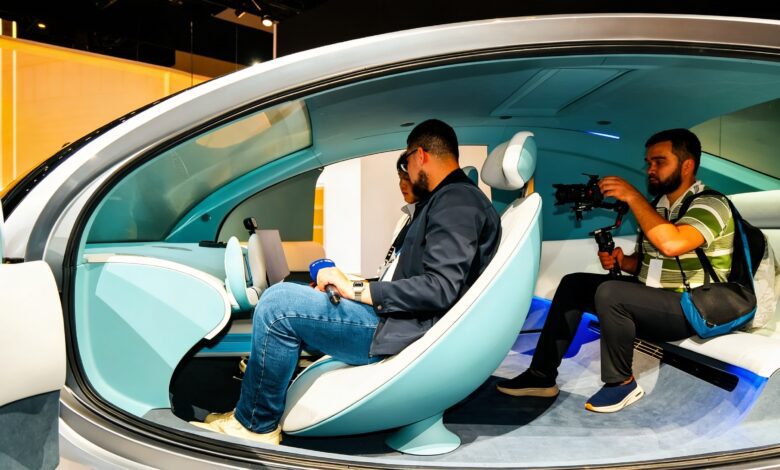
Geely unveiled the Eva Cab for the first time—a robotaxi prototype developed jointly with AFARI Technology and CaoCao Mobility. This model targets large-scale deployment of autonomous transport in China, but its technology platform and architecture could be of interest for European markets as well, including Spain, where the development of driverless services is under discussion. Eva Cab stands out in several areas: a design with electric sliding doors, a face-to-face seating arrangement with maximized interior space, and the integration of advanced solutions in safety and computing power.
A key feature is the EEA 4.0 architecture—the world’s first electronic-electrical system based on quantum AI, providing end-to-end encryption and data protection at both the vehicle and cloud levels. For the first time in the industry, a digital LiDAR with 2160-line resolution has been implemented, as well as production-ready L4 autonomous driving software. The computing platform includes three top-tier chips: NVIDIA SuperChip, NVIDIA Thor U, and Qualcomm Snapdragon 8397, delivering processing power exceeding 3000 TOPS—a figure currently out of reach for most mass-produced models on the market.
Geely notes that the Eva Cab has already undergone pilot tests in the cities of Hangzhou and Suzhou, with commercial operation planned for 2027. For Spain, where there are still no large-scale autonomous taxi services, such solutions could serve as an example for local operators and manufacturers. Notably, Geely became the first automaker to receive ISO 8800 AI Safety certification, highlighting its focus on intelligent safety.
4×4 Platform: New Energy for SUVs
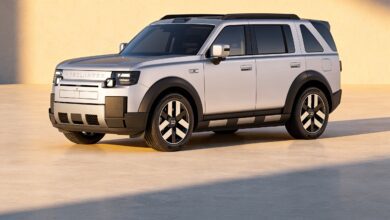
The second key innovation is an entirely new architecture for off-road vehicles with electrification and AI. Geely claims this is the world’s first native platform for off-road electric vehicles, developed based on 40 years of engineering experience. It features intelligent torque distribution, 4×4 modes with AI support, automatic regeneration, and active body position adjustment. For the Spanish market, where SUVs and crossovers remain consistently in demand, this architecture could become a technological benchmark for future models, especially in the premium and adventure segments.
The platform provides a configuration with three electric motors: a powerful P3 at the front and two independent P4 units on the rear wheels, delivering a combined output of over 1,000 hp and acceleration to 100 km/h in under five seconds. An important detail is the integration of a battery with six-layer protection and optimal 50:50 weight distribution between the axles, ensuring not only dynamic performance but also safety off-road. For Spanish buyers focused on modern off-road vehicles, such solutions may set a new standard in the coming years.
Technology and market context
Geely also showcased its current lineup in Beijing, including the Galaxy M9, Galaxy V900, Xingyao (Starshine) 8, Xingyue L (Monjaro) i-HEV, Galaxy M7, and StarWish (EX5). Some of these models are already available on European markets or are being considered for expansion, which reaffirms the brand’s strategy of globalization and technological leadership. In Spain, interest in Geely has grown significantly following the launch of the E5 electric crossover, which stood out for its range and price — more details about it can be found in the article on the launch of the Geely E5 on the Spanish market.
Overall, the solutions presented by Geely at the 2026 Salón de Pekín highlight the brand’s commitment to integrating AI, autonomy, and new mobility formats. For the Spanish market, this serves not only as a technological benchmark, but also as a sign of potential new models and services that could reshape the familiar landscape of the electric vehicle and SUV segment.